The RV park versus state park question usually gets answered with a shrug: state parks are cheaper and prettier, private parks have hookups and Wi-Fi, pick your priority. That is roughly true and almost useless, because the real answer flips depending on the month you're traveling, the length of your rig, and how far ahead you're willing to commit.
Fair disclosure up front: we run a private RV park in Easton, 22 sites at I-90 Exit 63, and we're five minutes from Lake Easton State Park. We have watched both sides of this comparison for years, and there are plenty of trips where the state park is the right call. This guide is the version we'd give a friend, with every state park figure pulled from Washington State Parks' own published pages.
What each one actually costs
State parks publish their rates; private parks generally don't, which is half the reason this comparison is hard to make honestly.
Per the Washington State Parks fee schedule, a campsite runs by season and by hookup class:
- Standard (no hookups): $31–43 peak, $23–35 shoulder, $23 winter
- Partial utility: $41–51 peak, $35–46 shoulder, $35 winter
- Full utility: $46–56 peak, $41–51 shoulder, $41 winter
Peak is May 15 through September 15. Shoulder is April 1 to May 14 and September 16 to October 31. Winter is November through March.
Then the add-ons, which are where a "cheap" state park night quietly grows: a reservation fee of $8 online or $10 by phone, an additional $15 per reservation if you are not a Washington resident, and $10 per night for each vehicle beyond the one included with the site. A tow vehicle plus a second car on a full-hookup site in July is a $56 site plus $10 plus $8, before tax.
The Discover Pass is the one fee you can skip. Per the state, a registered camper doesn't need the $10 daily or $45 annual pass at the park they're staying in — the camping registration on the dashboard covers day-use parking.
Private RV parks in Washington vary too widely to give one number, and we're not going to invent an average. Ours are on the booking page and change by season. The honest framing: a private park with electric and water will usually cost more per night than a standard state park site and land somewhere near a full-utility state park site. What you're paying for is the next four sections.
Booking: the nine-month race versus a phone call
This is the biggest practical difference, and it's not about money.
Washington State Parks opens reservations "up to nine months in advance of the first date of your trip," and the popular parks fill on the day the window opens. A Fourth of July hookup site at a Puget Sound or Cascades park means booking in early October. Same-day reservations are accepted until 2 p.m. on your arrival date, and first-come, first-served sites exist, but at the parks you actually want in summer, they're gone by Thursday.
The cancellation math is the part almost nobody reads. State Parks charges a percentage of the total cost of all canceled nights, and the percentage goes up the longer you've held the reservation: 5% if held less than a month, 10% at one to two months, 15% at two to three, 20% at three to four, 30% at four to five, 40% at five to six, and 50% if you've held it more than six months. Plus the $8 or $10 change fee. Read that again in the context of the nine-month window: the reservation you were forced to make in October to get a July weekend is the one that costs half its value to cancel in June. A no-show — not arrived by 1 p.m. the day after your scheduled arrival — gets nothing back.
Private parks set their own terms, and they're usually simpler and tied to the calendar rather than to how long you've held the booking. Ours: 14 or more days out is a full refund of the deposit minus a processing fee, 7 to 13 days is 50%, inside 7 days is forfeited. Summer weekends carry a 2-night minimum. And if a site is open next weekend, you can have it — 425-622-2790, no nine-month lead time.
Edge: state parks if you plan a year out and never cancel. Private if your plans move.
Hookups: "utility site" is a category, not a promise
State park campgrounds range from no hookups at all to full hookups with sewer, and the mix varies by park. Two things trip RV travelers up.
First, the water. As we documented in our guide to RV parks open year-round in Washington, most state parks that stay open in winter shut the water off around November 1 and turn it back on around April 1. A loop can be open, reservable, and charging a utility rate while the spigot at your site is capped. Only a handful of parks keep hookup water on all winter, and none of them are in the Cascades.
Second, the length limit. The Lake Easton State Park page says "some sites accommodate up to 60-foot RV units," which is generous. Dash Point in Federal Way "accommodates RVs and combinations of 32 feet or less." Kanaskat-Palmer tops out at 50 feet with limited availability. The length limit eliminates more parks than price does, and it's listed on each park's page below the photos.
A private park's utilities are the product, so they're at every site and they're on. That said, "private" doesn't automatically mean "full hookup" either — we're an example. Every one of our 22 sites has 30/50-amp electric and water, but there's no sewer at the sites; the dump station is on the property. If you need sewer at the pad, a paved-resort-style park in the Bellevue or Issaquah corridor is the better answer, and our guide to RV resorts in Washington explains the difference between a park and a resort before you book either.
Edge: private for reliability, on the plain fact that the utilities are the reason the place exists. State parks can match it in summer if you land a full-utility site and your rig fits.
Rules and stay limits
State park rules are statewide and published in one place, which is genuinely convenient. The ones that shape an RV stay:
- Stay limit: "no more than 10 nights in one park within a thirty-day period," and no more than 90 nights per calendar year across all state parks combined
- Check-in 2:30 p.m., check-out 1 p.m.
- Quiet hours 10 p.m. to 6:30 a.m.
- Generators 8 a.m. to 9 p.m. — which matters on a standard site, because a standard site is where you'll be running one
- One camping party per site, maximum of eight people
- Pets on a leash no more than eight feet
The 10-night cap is the one that changes plans. If you're working remotely for three weeks or spending a month in the mountains, a state park requires you to leave and go somewhere else after ten nights. Private parks set their own limits, and most will happily take a longer stay off-season — ask.
At our place: check-in 3 p.m., check-out 11 a.m., a 2-night weekend minimum in June through August, fire pits available with firewood for sale on site (subject to burn restrictions, which we'll tell you about at check-in), and no generator needed because every site has power. Pet policies vary by site, so call before booking if you're bringing a dog. Wi-Fi is limited to common areas, and we'd rather be upfront about that than promise streaming.
Edge: state parks for predictability — the rules are the same at every park. Private for flexibility on length of stay.
Setting: the state parks win on scale, and it's not close
Here is where the state park earns its price. Lake Easton State Park is "a 697-acre camping park with 24,000 feet of freshwater access." Steamboat Rock has 50,000 feet of shoreline on Banks Lake. Kachess Campground, the national forest option at Exit 62, puts you on a reservoir several miles long for $27 a night. No private park in the state competes with public land on the size of the water or the size of the trees.
What the state park can't control is what's next to it. The Lake Easton page states plainly: "Due to the campgrounds' close proximity to I-90 and highway noises, earplugs are recommended for light sleepers." That is the state's own language, and it applies to a lot of Washington's most convenient public campgrounds, which were built beside the highway because that's where the flat ground was.
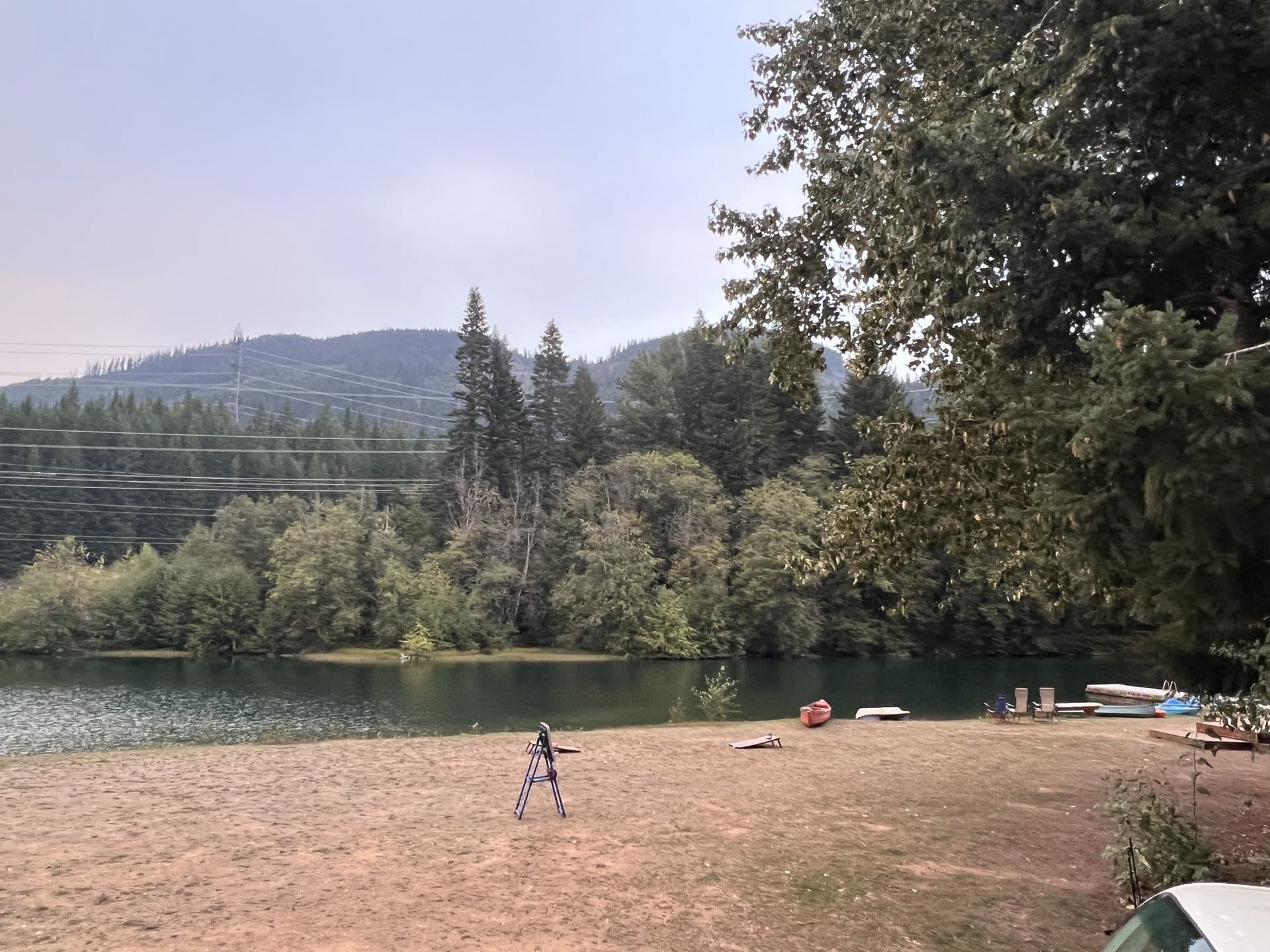
A private park's setting is whatever the owner has. Ours is 54 acres set back from the freeway, with four private stocked lakes, free kayaks, canoes, paddle boards and paddle boats, and no fishing license required because the water is private. There are sheep, alpacas and horses on the property and deer that wander through. It is smaller than a state park in every direction and quieter in the one that matters at 2 a.m. Our private lake fishing page covers what's in the water.
Edge: state parks for landscape. Private for quiet and for having the lake to yourself.
The calendar decides more than anything above
Everything so far assumes both options are open, and for half the year in the Cascades they aren't.
Lake Easton State Park's campground is closed November 1 through May 1. The I-90 national forest campgrounds — Tinkham, Denny Creek, Kachess — run roughly May or June through mid-September. Our Kittitas County camping guide walks through every public campground in the county by elevation, and the pattern holds: the higher and closer to the pass, the shorter the season. Along I-90 between North Bend and Ellensburg there is effectively no public hookup camping from November to May.
Private parks that stay open are the entire winter inventory in the mountains. We don't close. The trade is that winter here means the lakes ice at the edges and the boats come off the water — you're getting hookups, snow, and the Summit at Snoqualmie 20 minutes west, not a summer weekend with the heat turned down.
Edge: state parks June through September, when they're open, cheaper, and at their best. Private October through May, when the alternative is often nothing.
The short version
Pick the state park when:
- You're traveling between Memorial Day and mid-September and booked nine months out
- Your rig is under the park's published length limit — check this first
- You want the biggest water and the longest shoreline, and you'll sleep through highway noise
- The trip is ten nights or fewer and your dates won't move
Pick the private RV park when:
- You're traveling November through April in the Cascades, where public hookups don't exist
- You want water at the site, not at the dump station, in the cold months
- Your plans might change — calendar-based cancellation beats a 50% fee
- You're staying longer than ten nights
- You'd trade shoreline miles for a lake with nobody else on it
And if you're comparing specific parks rather than categories, our RV camping near Seattle guide sorts the options within 90 minutes of the city by length limit, hookup class, and season. The tent camping side of our property runs on the same calendar as the RV sites, and the same comparison applies.
Conditions as of September 2026
State park rates, reservation and cancellation fees, stay limits, check-in times, and the Lake Easton campground closure dates above are as published on the linked Washington State Parks pages on the date of this post. State Parks adjusts fees periodically and closure dates by season. Our own policies are as published on our cancellation policy page; confirm current rates on the booking page before you plan around them.