The call usually comes the afternoon before an arrival: is the pass going to be okay?
The honest answer is that nobody knows on Thursday what I-90 will be doing on Saturday. The useful answer is that the rules governing that drive are published, specific, and almost never read before people leave — and most of the trouble on this road comes from a driver who did not know what the sign meant rather than from the weather.
We sit at Exit 63, about 20 minutes east of the summit, so most guests from Seattle cross the pass to reach us. Here is the whole thing in one place: what the signs legally require, what counts as a traction tire, why the road closes on clear days, and what to do when it does.
The short version
- Three chain signs exist in Washington law. They escalate, and only the third normally requires a two-wheel-drive car to chain up.
- All-wheel drive is an exemption, not a free pass — and it comes with a condition most AWD drivers do not meet.
- Approved traction tires are a specification, not a vibe: 4/32 of an inch of tread plus an M+S or mountain-snowflake marking.
- Studded tires never satisfy a chain requirement, and they are only street-legal here November 1 through March 31.
- Ignoring a posted chain sign is a $500 infraction, written into the statute itself.
- The pass closes for avalanche control on days with blue sky. Typical delay: 30 minutes to two hours.
What the signs actually say
This is the part worth memorizing, because the wording is set by statute. RCW 47.36.250 authorizes exactly three legends, in escalating order:
- "Traction advisory - oversize vehicles prohibited."
- "Traction advisory - oversize vehicles prohibited. Vehicles over 10,000 GVW - chains required."
- "Traction advisory - oversize vehicles prohibited. All vehicles - chains required, except all wheel drive."
WSDOT's roadside and app wording is friendlier — traction tires advised, traction tires required, chains required — but these three are the legal backbone. The same statute sets the penalty for ignoring one: a traffic infraction "with a penalty of $500 including statutory assessments." WSDOT puts it more bluntly in its winter preparation release: "Drivers who fail to install chains when signs are posted risk a $500 fine."
Here is what each level means for the three kinds of vehicle that drive past our exit, drawn from WSDOT's winter driving guide and WAC 204-24-050:
Traction tires advised. Recommended for everyone, required of nobody — except that a vehicle over 10,000 pounds is still carrying chains, because that obligation runs on the calendar rather than on the sign.
Approved traction tires required. A two-wheel-drive car needs approved traction tires on its drive wheels. All-wheel drive needs the same tires and chains in the vehicle. Heavy vehicles chain up according to axle configuration.
Chains required, except all-wheel drive. Chains go on a two-wheel-drive car, no exceptions. All-wheel drive is exempt only under the three conditions in the next section. Heavy vehicles chain up and carry two spare chains.
Chains required on all vehicles. Everyone chains up.
That last level is the one people do not expect, and it is the State Patrol's call rather than WSDOT's: under extreme conditions troopers can require every vehicle on the road to chain up, all-wheel drive included. It is rare. It happens.
The AWD condition nobody reads
The exemption on sign three is real, and it is conditional. WAC 204-24-050 exempts all-wheel drive vehicles from a posted chain requirement only when all wheels are in gear, the vehicle is on approved traction devices, and it is carrying tire chains for at least one set of drive tires.
Read that last clause again. A Subaru on all-season tires with nothing in the trunk is not exempt — it is simply unequipped, and a trooper at a chain enforcement point can treat it that way. The chains do not have to be on the wheels. They have to be in the car.
The same rule points to a practical escape hatch for vehicles that physically cannot take chains: the State Patrol publishes a list of approved alternative traction devices, and devices on that list count. The rule also rules out one shortcut by name — "Plastic chains will not be allowed."
What counts as an approved traction tire
Not a judgment call. WAC 204-24-040 defines it: "A minimum of 4/32 inch tread, measured in the center portion of the tire," plus a sidewall marking — either the words "mud and snow" (or an M+S contraction) or "the mountain/snowflake symbol." The tread pattern has to be an actual snow design, with lugs angled more than 30 degrees off the centerline and shoulder lugs projecting at least half an inch on one side.
Four thirty-seconds is an eighth of an inch, which is the figure WSDOT uses in its public guidance. A quarter dropped head-down into the tread is the old roadside check: if you can see the top of Washington's head, you are under an eighth of an inch and your tires are not approved traction tires, whatever the sticker in the glovebox says.
And studs are not chains. WSDOT is explicit that studded tires do not satisfy a chain requirement, and that "studded tires are legal for use in Washington state only from Nov. 1 through March 31."
The carry-chains zone is far longer than the pass
Driving a truck, a dually under a fifth wheel, or anything else over 10,000 pounds? The legal geography is bigger than most people assume. WAC 204-24-050 names twelve mountain routes where heavy vehicles must carry sufficient chains from November 1 to April 1, and the I-90 entry reads: "I-90 - Between North Bend (MP 32) and Ellensburg (MP 101)."
That is 69 miles. It starts in the foothills, long before the climb, and it does not end until you are out the other side and down in the Kittitas Valley — our Exit 63 sits squarely in the middle of it. WSDOT's commercial chain rules add that over-10,000-pound vehicles "must carry at least two extra tire chains," and that between November 1 and April 1 chains "must be carried at all times, regardless of road conditions or advisories." No advisory required. No snow required. If you are towing to our RV sites in February, that applies to you — our guide to RV parks open year-round in Washington covers the rest of the cold-weather towing picture.
Why the road closes on a clear day
The most common winter frustration here has nothing to do with how anyone is driving. I-90 over the summit is one of only two corridors in the state where WSDOT runs avalanche control all winter, and control work means closing the road on purpose.
WSDOT describes it as "a winter-long activity" on two corridors — this one and US 2 over Stevens Pass — and locates the most persistent zone here "on the west side of the pass area." Crews trigger slides deliberately with explosives "placed by hand, cable-pulley bomb trams, or with surplus military weapons," including a 105mm howitzer when artillery is the right tool. While that happens, the highway is shut.
The number worth planning around comes from the same WSDOT avalanche page: "Traffic delays are typically 30 minutes to two hours," and in severe conditions they can run several hours. Crews "strive to perform avalanche control work at night or during periods of lower traffic volume," which helps, but a Saturday morning closure is not unusual.
Scale explains why a two-hour closure feels worse than it sounds. WSDOT puts typical volume over the 3,022-foot summit at "about 28,000 vehicles per day and about 5,600 of those vehicles are freight." When that queue releases, you are not alone on the road.
Two more things to know. There is no quick detour: Stevens Pass to the north and White Pass to the south add hours and carry their own restrictions, and WSDOT closes Chinook Pass, Cayuse Pass, and SR 20 over Rainy and Washington passes for the season outright, because control work in those areas is too hazardous. And you will be driving through a construction corridor for years yet — the I-90 Snoqualmie Pass East project is rebuilding 15 miles from Hyak to Easton, widening it to six lanes, adding avalanche bridges and expanding chain-up areas, with the Cabin Creek to West Easton phase under construction since fall 2022. That is literally our stretch. The two snowsheds it is designed around, at Lake Keechelus and Airplane Curve, were built in 1950.
Five minutes before you leave
- Check the WSDOT real-time Snoqualmie Pass report. It publishes current restrictions and camera images, not a forecast. The free WSDOT app does the same thing from the passenger seat, and 511 reads it to you.
- Put chains in the car even if you are sure you will not need them. Buy them for your tire size, and open the bag once in a dry driveway rather than in the dark on a shoulder.
- Fill the tank before you climb. There is no fuel in the middle of a closure queue, and idling for warmth burns it.
- Carry the boring things: water, snacks, a blanket, a charged phone and a charger, a headlamp, gloves. Two hours stopped is normal here.
- Do not pass a snowplow. WSDOT asks drivers to stay back 15 car lengths; plow operators have limited visibility and can throw snow from either side.
- Set out early. Restrictions can appear between Seattle and North Bend, and a car that leaves at nine has options a car leaving at five does not.
Getting to us, specifically
We are at 3000 U-Fish Rd, I-90 Exit 63, then a mile and a half down the road — about 80 minutes from Seattle when the pass is behaving. Two details matter in winter.
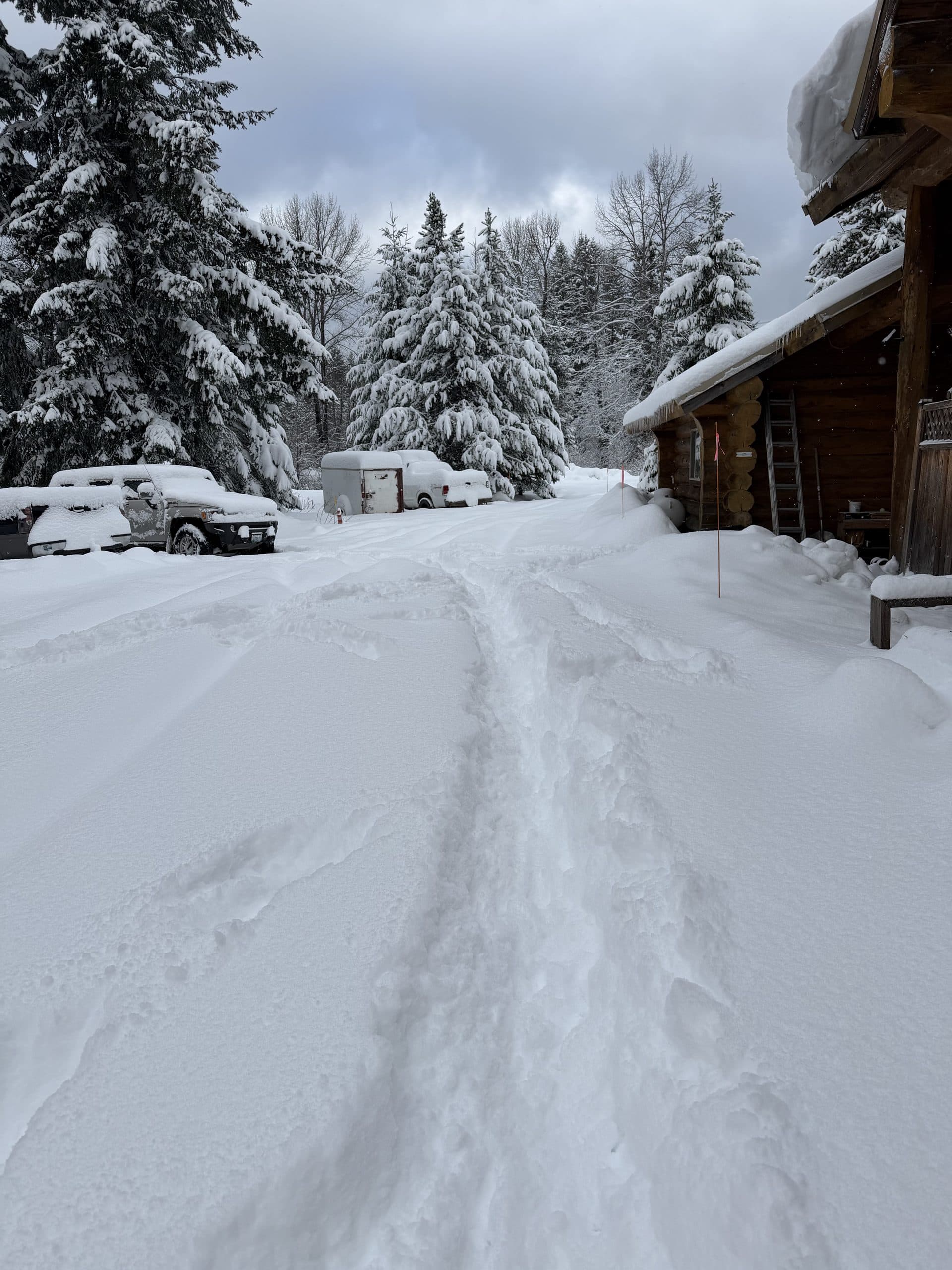
First, elevation. The summit is 3,022 feet; we are at roughly 2,200. That 800-foot difference is often the difference between snow and rain, and it is why the parking lot here is usually easier than the one at the ski area. Our guide to when Snoqualmie Pass gets snow has the gauge data behind that.
Second, which side of the summit you approach from. Coming from Seattle, a closure sits between you and your cabin. Coming from Ellensburg, Yakima, or Spokane, you never touch the summit at all — which is the quiet advantage of staying east of the pass, covered in our Snoqualmie Pass lodging guide.
If the pass is ugly on your arrival day, call us at 425-622-2790 rather than driving on hope. We are open year-round, winter is our quietest season, and a night moved is better than a night spent in a queue at Hyak. When you do get here, winter cabin rentals covers what is heated and what is not, and winter activities near Snoqualmie Pass covers what there is to do once the car is parked.