
Short answer: usually no — but not because the land is private. In Washington, a privately owned lake becomes license-free only when the Department of Fish and Wildlife has determined that state licensing and state fishing regulations don't apply to that specific body of water. That determination happens through WDFW's fish stocking permit process, not automatically because someone owns the shoreline.
That distinction matters, and it's the part almost every version of this answer online gets wrong. We say "no license required" on most pages of this site, so it's fair to explain exactly what sits behind it.
The baseline: a license is required unless something says otherwise
Start with the statute. RCW 77.32.010(1) reads:
"Except as otherwise provided in this chapter or department rule, a recreational license issued by the director is required to hunt, fish, or take wildlife or seaweed."
Two things follow from that sentence. First, the default answer in Washington is yes, you need a license — WDFW states plainly that "All fishers age 16 and older need a fishing license." Anglers 15 and younger don't need one anywhere in the state. Second, any exemption has to come from somewhere specific: the chapter itself, or a department rule. "It's private property" is not one of those places.
Private ownership by itself doesn't exempt the water
This is the common misconception, and it's worth stating directly: owning the land around a lake does not, on its own, exempt the fish in it from state regulation. Washington's fish are managed as a public resource regardless of who owns the dirt. If you dig a pond on your own property, put nothing in it, and catch whatever swims in on its own, you have not created a license-free zone by virtue of the deed.
What creates the exemption is a determination by WDFW about that particular water.
How a private lake actually becomes license-free
The mechanism is the Fish Stocking Permit. Per WDFW, "A Fish Stocking Permit from WDFW is required to plant fish into lakes or ponds in Washington State," and "It is illegal to transfer or stock fish without a permit issued by WDFW."
Getting one is not a form you mail in. When the application arrives, a WDFW fish biologist arranges an on-site evaluation. The site parameters the biologist reviews include water quality and quantity, inlet and outlet structures, connections to nearby waters, and flooding potential. WDFW notes that "Screening may be necessary in some lakes or ponds to keep fish from leaving." The biologist also reviews the owner's proposed stocking plan — which species, at what rates, and how they'll mesh with the pond's habitat.
And then the sentence that answers this whole page:
"The biologist will also review with the owner whether state fishing licenses and state fishing regulations apply to the lake or pond."
That's the hinge. Licensing and regulations are settled water by water, in conversation with the department, as part of the permit. It isn't a blanket statutory carve-out for private land, and it isn't the landowner's call.
The practical details, also from WDFW: there's a $24 stocking fee and a $70 processing fee ($94 total), the processing fee is non-refundable, it "generally takes the department less than 30 days to issue a fish stocking permit," and permits are issued for a one-year period.
Why the rule is built this way
The reasoning isn't bureaucratic. WDFW's concern is that stocked fish escape and cause problems — through predation on or competition with native species, and by carrying disease agents into waters that don't have them. That's why the evaluation cares so much about inlet and outlet structures, connections to nearby waters, and flooding potential: a pond that spills into a creek in a wet spring isn't really a closed system, and a lake that genuinely is one poses almost no risk to anything outside it.
Which is also why the licensing question gets answered differently for different ponds. A contained, screened, stocked private lake with no public access is a very different management problem from a pond that drains into a salmon-bearing stream.
What "no license" does and doesn't get you
On a private water where WDFW has determined state licensing and regulations don't apply, the exemption is broader than just the license card. There's no state opener to wait for and no state season dates, which for trout fishing in Washington is often the bigger deal — you're not planning a trip around a late-April opening day.
What it doesn't get you:
- It isn't lawless. It's someone's private water, and the owner's rules govern it — limits, catch-and-release stretches, gear restrictions, hours. Those are enforced as property rules rather than state regulations, but they're still the rules.
- It doesn't travel. The exemption covers that water, not the river a mile down the road. Cross the property line and you're back under state rules immediately.
- It isn't a guess you get to make. If you're fishing a private lake as a guest, the exemption is the owner's to have established. If you own water and haven't been through the permit process, don't assume.
Fishing public water nearby? You need a license
Worth being clear about, because most trips out here include both. Every public lake and river in the state — including everything within easy reach of Easton — requires a license for anyone 16 or older. Current fees from WDFW, effective January 1, 2026:
| License | Cost | |---------|------| | Resident annual freshwater (16-69) | $39.95 | | Resident annual freshwater (70+) | $9.59 | | Resident 1-day combination | $14.90 | | Non-resident annual freshwater | $115.85 | | Non-resident 1-day combination | $27.05 | | Anglers 15 and younger | No license needed |
Separately, a catch record card is required if you're fishing for salmon, steelhead, sturgeon, halibut, or Puget Sound Dungeness crab — and on that one, WDFW is explicit that "Everyone, including those younger than 16, must carry a catch record card when fishing for these species." None of those are what you'd be catching in a Kittitas County lake, but it's the rule people most often miss.
For what's actually fishable near here and which waters need what, our fishing guide for Easton, WA covers Lake Easton, the Yakima River, Kachess, and Keechelus with the license requirement noted for each.
Free Fishing Weekend is a different thing
Washington sets aside a weekend each year when no license is required for many species — the 2026 dates were June 6-7. It's a real exemption, but a narrow one, and it's not the same as a private-water exemption.
On Free Fishing Weekend, shellfish, salmon, steelhead, sturgeon, and halibut still require a license. More importantly, seasons, size limits, bag limits, and area closures all still apply — the state waives the license, not the rulebook. That's the clearest contrast with a license-free private lake, where the absence of a state season is the whole point. WDFW sets the dates annually, so check before planning around it.
How this works at our lakes
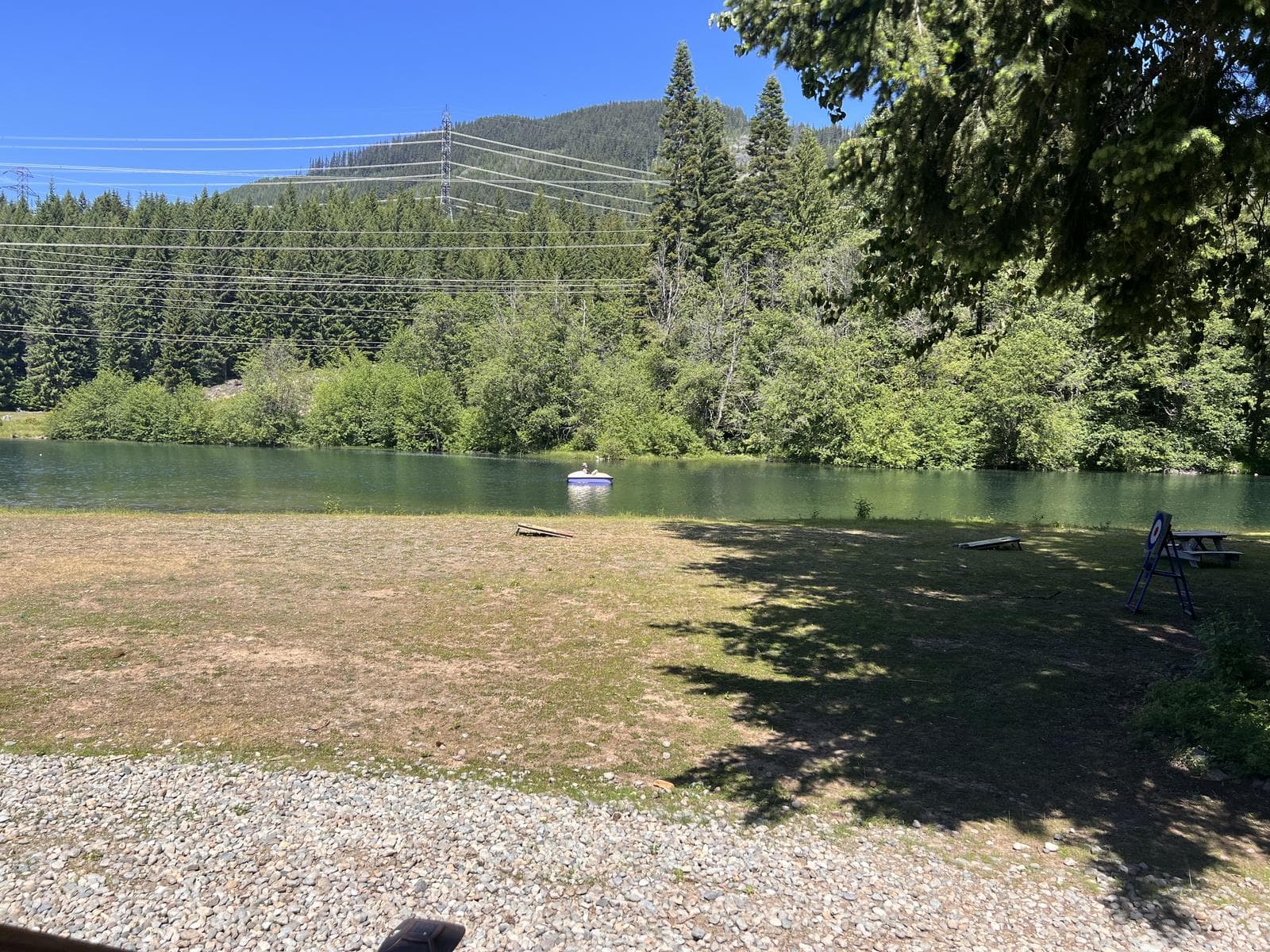
Our four lakes sit inside the property boundary at 3000 U-Fish Rd off I-90 Exit 63 — private, stocked, no public access, and no Washington fishing license required to fish them during your stay. One of the four is catch and release. There's no opener to wait for, which is why guests fish in March and October as readily as July.
Our rules, not the state's: bring your own rods, tackle, and bait, because we don't rent gear or run a tackle shop. Motorized boats are not permitted on any of the four lakes — kayaks, canoes, paddle boards, and paddle boats are free for guests in the warm months. We don't have a guide service, a restaurant, or a fish-cleaning station. If you want a full-service operation, our roundup of fishing lodges in Washington state lays out what the other five categories of property actually offer.
What the lakes are good for is the thing that's hard to buy elsewhere: water you can walk to from a lakefront cabin porch, without a license, without a crowd, and without checking a season table first. The full picture is on our fishing page.
If you own a pond and want to stock it
Short version: start with WDFW's fish stocking and transport permit page, and apply before you buy fish. Stocking without a permit is illegal, and the licensing question you actually care about gets answered during the biologist's visit — so doing it in the right order is how you find out where your water stands.
Questions about fishing during a stay here? Get in touch or call 425-622-2790. If your trip also includes public water, buy the license ahead of time — it's cheaper than the alternative, and WDFW sells it online.