Taking a kid fishing near Seattle comes down to three questions, and only one of them is about fish. Do we need licenses. Where can we go that does not need a boat. And will there actually be anything in the water when we get there.
All three have specific answers, and the first one has changed recently enough that a lot of what you will read elsewhere is wrong.
We run four private stocked lakes on 54 acres in Easton where no license is required at all, so we have an obvious interest here. Everything below about public water is quoted from the Washington Department of Fish and Wildlife, and our own entry is at the bottom where you can weigh it against the rest.
The license age is 16, not 15
This is the part worth getting right, because the threshold moved and most third-party guides have not caught up.
WDFW's fishing licenses page states the baseline plainly: "Residents and non-residents alike must have a license to fish or shellfish in Washington waters." Then the age: "All fishers age 16 and older need a fishing license."
The license types and fees page carries the matching footnote — "Anglers 15 years and younger do not need a fishing license."
So for a family trip: the kid fishes free through age 15. The adult who drove, rigged the rod, and is holding the net needs a license. That is the whole arrangement, and it is a better deal than most parents assume.
Older WDFW pamphlets — and a great many blog posts, forum answers, and printed guides still circulating — say 15. They are out of date. If your child is 15, the current rule is that they do not need a license; under the old one they did. Check the live page rather than a PDF from a few seasons back.
What it costs the adult
From the same fees page, for residents:
- Annual freshwater — $39.95, listed as "Freshwater (includes a Vehicle Access Pass)," so the parking pass for WDFW water access sites comes with it
- One-day combination — $14.90
- Two-day combination — $20.98
- Three-day combination — $25.53
- Two-Pole Endorsement — $20.23, only needed where two-pole fishing is allowed
For one afternoon at a lake with a seven-year-old, the one-day license at $14.90 is usually the right instrument. If you expect to go three or four times in a year, the annual pays for itself and brings the Vehicle Access Pass with it — which matters, because parking is its own separate question in Washington. Our recreation passes explainer sorts out which pass covers which lot.
The catch record card catches people out
One exception that surprises parents, straight from the licenses page: "Everyone, including those younger than 16, must carry a catch record card when fishing for these species."
The species are salmon, steelhead, sturgeon, halibut, and Puget Sound Dungeness crab.
For a trout afternoon at a lowland lake — which is what fishing with young kids almost always means — this does not apply. But if the trip is a salmon outing on the Sound, your unlicensed ten-year-old still needs their own catch record card. The license exemption and the catch record card requirement are two different rules, and only one of them has an age cutoff.
Free Fishing Weekend: the one weekend nobody needs a license
Washington waives the license requirement entirely for one weekend a year, and the date is set by a formula rather than announced fresh each time. Per WDFW: "Free Fishing Weekend in Washington is always the first weekend after the first Monday in June." The page currently states: "The next Free Fishing Weekend is June 12–13, 2027."
What is waived that weekend:
- The fishing license, for everyone
- The Vehicle Access Pass, and the Discover Pass is not required to park on land managed by DNR, Washington State Parks, or WDFW
- The Two-Pole Endorsement, where it applies
What is not waived: "Licenses are still required to fish for or harvest salmon, steelhead, sturgeon, halibut, and all shellfish." And the broader caveat — "All other rules still apply," including size limits, bag limits, and area closures.
The honest footnote on Free Fishing Weekend is that every accessible lake within an hour of Seattle has the same idea that weekend. It is a genuinely good introduction if your kid has never held a rod and you would rather not spend $14.90 finding out whether they like it. It is not the weekend to go looking for solitude.
Where to go near Seattle without a boat
Two things make a lake work with a child: you can fish from solid ground, and there are fish in it. WDFW publishes both facts on every lake page — a "Shoreline access" rating and a note on docks or piers.
Green Lake, north Seattle (250 acres). WDFW calls it "This urban fishery in north Seattle is one of the best trout fisheries in Western Washington," and the detail that matters for a family is seasonal rather than geographic: "Stocked rainbow trout and brown trout are readily catchable year-round." Shoreline access is rated "Good," with "fishing docks located at the south, east and northeast shores of the lake," and "Two-pole fishing is allowed." Beyond trout the lake holds largemouth bass, pumpkinseed sunfish, brown bullhead, rock bass, channel catfish, and common carp — and a kid who catches a six-inch sunfish off a dock has had a good day regardless of what you were targeting.
Lake Wilderness, Maple Valley (66 acres). Stocked with rainbow trout, shoreline access rated "Good," with bank access at Lake Wilderness Park on the northwest shore, which includes a shoreline and a fishing pier. One caution worth reading before you drive: WDFW notes it is "one of only ten waters in King County managed with a seasonal fishing closure," so check the current regulations for this lake specifically rather than assuming it is open. If you are bringing a small boat, the WDFW access has "a shallow, gravel boat ramp best suited for car-toppers and inflatable watercraft."
Rather than work from a list of lakes that goes stale — and most published lists of "best kid fishing lakes near Seattle" have gone stale — use the two WDFW fields directly. Open any lowland lake page, read the shoreline access rating, and look for a pier.
How to find out what was stocked this week
This is the part that separates a good afternoon from a boring one, and WDFW publishes it.
The catchable trout plant report is a searchable record of recent hatchery stockings. It shows the last 30 days by default, and you can filter by county, species, hatchery, and region, search by lake name, or sort by stock date. The report runs January 1 to December 31, Monday through Thursday.
Two limits to understand before you rely on it:
- It is catchable fish only. The page states: "This page only shows catchable trout" — fish three per pound or larger, including broodstock. Fry and fingerlings are in a separate statewide stocking plan, and they are not what you want your kid casting at.
- A stocking is not an opening. WDFW warns directly that "Stocking may occur before a lake is open to fishing," and that regulations, not stocking dates, determine when fishing is allowed. A truck visited on Tuesday does not mean you may fish there on Saturday.
Check the plant report for the county, then check the regulations for the specific lake. In that order.
What actually makes it work with a kid
Four things, learned from watching a lot of families fish our lakes:
- A dock beats a shoreline. Solid footing, room to stand, and no backcast into a blackberry thicket. It is the single biggest predictor of whether a young child stays interested.
- A bobber beats a lure. Something visible for them to watch means the waiting has a focus. A kid staring at a motionless rod tip is a kid asking to leave.
- Plan an hour, not a day. Two good hours with fish beats six hours of proving a point.
- Anything that pulls counts. The goal of a first trip is a bent rod, not a trout. Sunfish and perch are cooperative, abundant, and exactly the right size for small hands.
The other way to skip the license
There is a second route to a license-free afternoon that does not depend on one weekend in June: private water.
Washington's rule here is specific and widely misunderstood — private ownership by itself does not make a lake license-free, and the exemption runs through WDFW's stocking permit process rather than through the property line. We wrote the full explanation in do you need a fishing license on a private lake in Washington, including what the exemption does and does not cover.
The practical upshot for a family: on qualifying private water, nobody in the group needs a license, at any age, on any date, and there is no opener to wait for.
Where we fit, honestly
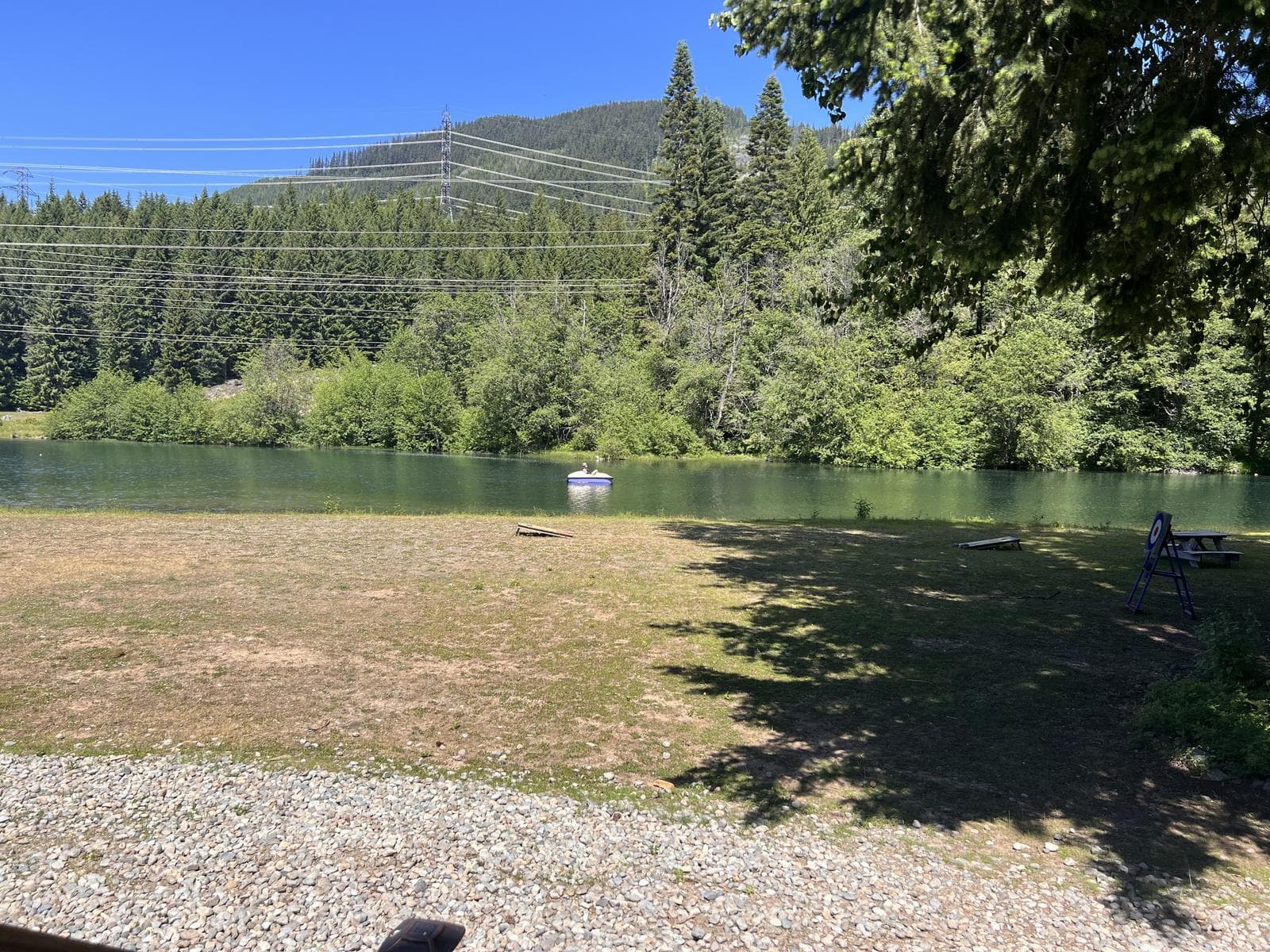
Our four lakes sit inside the property boundary at 3000 U-Fish Rd off I-90 Exit 63, about 80 minutes from Seattle — private, stocked, no public access, and no Washington fishing license required for anyone during a stay. One of the four is catch and release. There is no season table to check, which is why guests fish here in March and October as readily as July.
What we do not do: we have no tackle shop, no gear rental, no guide service, and no fish-cleaning station. Bring your own rods, tackle, and bait — that is the most common thing families arrive without. Motorized boats are not permitted on any of the four lakes; kayaks, canoes, paddle boards, and paddle boats are free for guests in the warm months.
Where Green Lake beats us: it is free, it is twenty minutes from most of Seattle, and you can go this afternoon. We are a trip, not an errand — you are booking a cabin, a tent site, or an RV site and making a weekend of it.
What the weekend gets you that the drive to Green Lake does not: water you can walk to from the porch, no license for anyone in the party, no crowd on the bank, and sheep, alpacas, and horses fifty yards away for the stretch when the fish stop biting. The full fishing picture is on our fishing page, and our local guide covers the public water around Easton if you want to combine the two.
Conditions as of October 2026
License ages, fees, Free Fishing Weekend dates, and the lake details above were taken from WDFW's published pages on the date of this post. WDFW sets Free Fishing Weekend annually and revises fees and regulations between seasons — and the license age itself changed recently, which is the reason this page leads with it. Confirm on the WDFW page before you buy, and check the regulations for the specific lake before you drive.