The old railroad grade that runs through this valley is the single most underused thing near us. People drive I-90 at 70 miles an hour with bikes on the roof, headed for Hyak, and never notice that the same trail they are driving to passes a few minutes from our front gate.
It has three names, which is most of the confusion. Officially it is the Palouse to Cascades State Park Trail. Locals and most trail signs still say Iron Horse Trail. Older maps and the annual horse ride call the eastern half the John Wayne Pioneer Trail. Washington State Parks consolidated all of it under the Palouse to Cascades name in May 2018 to end exactly that problem. Same trail, same gravel, three names.
Here is what it actually is where it crosses Easton, and what you need to know before you load a bike.
What the trail is
It is the roadbed of the Chicago, Milwaukee, St. Paul and Pacific — the Milwaukee Road — which gave up its western lines after the 1977 bankruptcy and was decommissioned in pieces between 1980 and 1987. The grade became a state park. The Cascade crossing it carried was electrified in 1919 at 3,000 volts DC, so the flat gravel path you walk was once a mainline with wire over it.
State Parks puts the whole thing at 251 miles, Cedar Falls near North Bend east to the Idaho border, split into three parts:
- West — North Bend area to the Snoqualmie Pass tunnel, 18 miles
- Central — the Snoqualmie Tunnel to the Royal City cut-off, 107 miles
- East — Warden to the Idaho border, 126 miles
Easton sits in the Central section, about 18 miles down the east side from the tunnel. The surface is gravel the whole way, and because it is a railroad grade, the climbing is almost nonexistent — the John Wayne Pioneer Wagons and Riders Association describes it accurately as "flat as it follows the paths of the former rail way lines with very slight grade."
One sentence from State Parks is worth reading before you plan anything ambitious: the trail "is not a fully improved, continuous 'cross state' trail," and several sections are closed to public access. Treat it as a set of good out-and-back rides, not a route you can string together on a whim.
Finding the Easton trailhead
This is the part that defeats people, because the trail does not announce itself from the freeway. Take I-90 Exit 71 into Easton. Coming the other direction, from the trail side, the Palouse to Cascades Trail Coalition describes the junction precisely: "In Easton the trail comes out past a house onto Cabin Creek Road. Go straight across this road at angle and to the right of the fire station." The fire station is the landmark. There is a graveled lot off the trail with room for a good number of vehicles.
You need a Discover Pass to park at any state park trailhead — $10 for the day or $45 for the year. If you are staying with us for a weekend and plan to visit Lake Easton State Park as well, the annual pass pays for itself on the second day.
There is a gas station in Easton with a small grocery selection and a restaurant, which is the entire commercial district. For anything more, Cle Elum is 15 minutes east — our guide to things to do in Cle Elum covers the bakery, the butcher, and the old Milwaukee Road rail yard in South Cle Elum, which is the other end of the ride described below.
Two rides out of Easton
West toward the tunnel — 17.9 miles to Hyak. This is the scenic direction and the harder one, because you are climbing the grade, gently, the whole way. The trail skirts Lake Easton and then Lake Keechelus, both irrigation reservoirs, and crosses a high curved bridge over Cabin Creek. There is a restroom but no potable water at Cold Creek, two miles below Hyak, and a campsite at Roaring Creek. Most people ride this as a shuttle: leave a car at Hyak, start at Easton, or the reverse and coast the 18 miles down.
East to South Cle Elum — 11.9 miles. Flatter, quieter, and the better choice with kids or a loaded horse. The trail parallels I-90 for a stretch, then veers south away from the noise and crosses the Yakima River. South Cle Elum has full services a short way north. From there the next segment runs another 18.5 miles to Thorp, if you want a longer day.
For walkers rather than riders, the 5.2-mile loop at Lake Easton State Park uses a section of this same rail trail — tunnel included — and is a much easier introduction. Our hiking page lists what is walkable straight from a cabin porch, and our guide to hiking trails near Easton covers the bigger climbs up toward the pass.
The Snoqualmie Tunnel is a summer thing
The 2.3-mile tunnel at Hyak — 11,894 feet, straight under the pass — is the famous part of this trail, and it is closed half the year. State Parks states it plainly: "The Snoqualmie Tunnel is closed from Nov. 1 - May 1, the re-opening date is weather dependent." In 2026 it opened on May 8.
So if you are coming in October hoping to ride through it, check the date first. From the Hyak trailhead at I-90 Exit 54 it is a 5.3-mile round trip with no elevation gain. Bring a real headlamp, not a phone, and bring a layer — it is cold and dripping inside even in August. Our guide to Snoqualmie Pass in summer covers the tunnel alongside the rest of the warm-season list and the weather data behind it.
The rules, which are short
From the State Parks trail page:
- Day use only. No camping on the trail itself. Lake Easton State Park has the nearest public campground, about a mile off the trail near Easton — and it is closed November 1 through May 1.
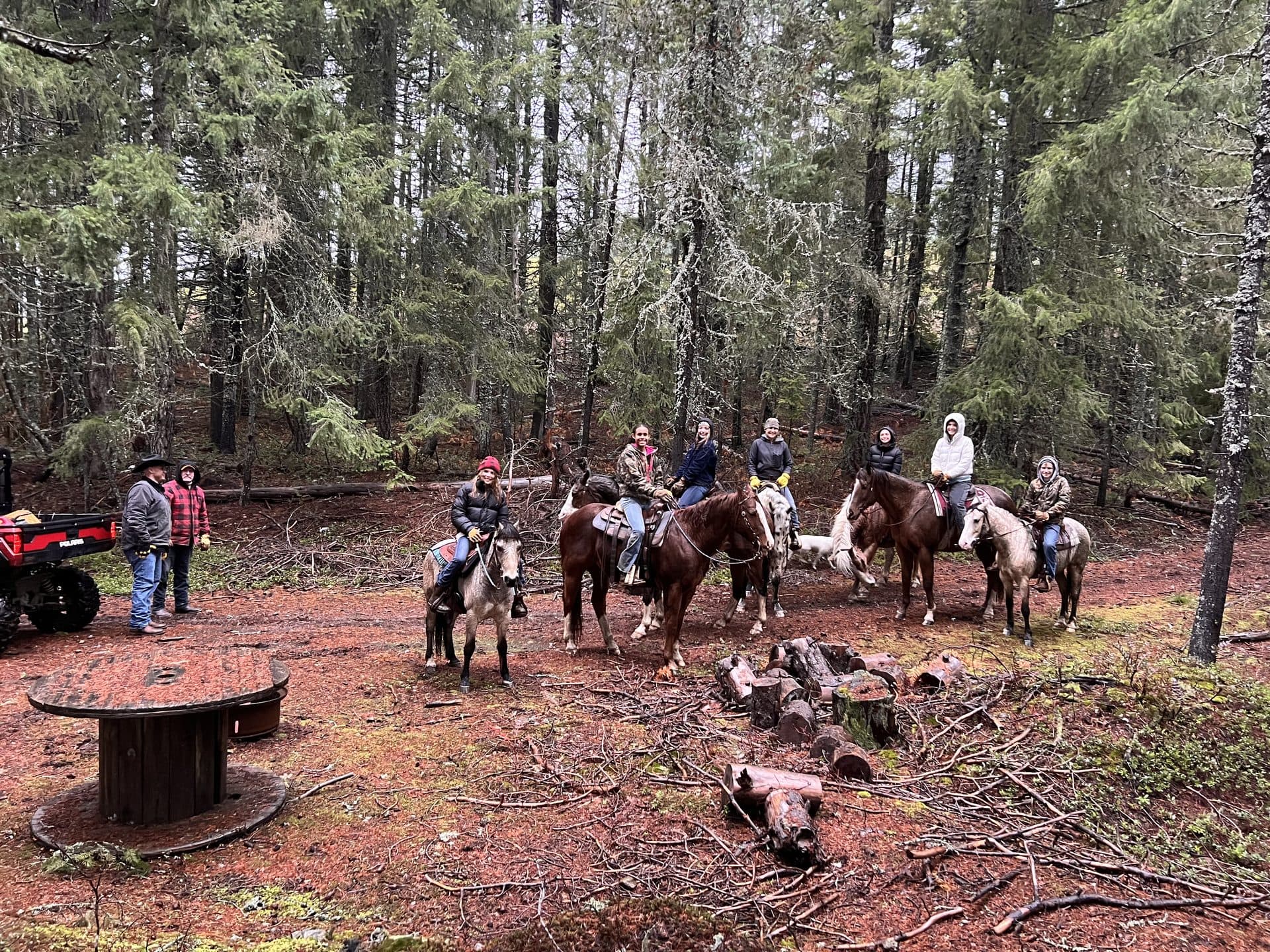
- Dogs allowed on leash. Horses allowed. This is one of the few long trails in the state built for stock, and the annual John Wayne Pioneer ride is why.
- No fires permitted at any time. That is a standing rule here, not a seasonal burn ban.
- No motorized use, with one local exception. State Parks: "You may ride your snowmobile only from Stampede Pass Road to Cabin Creek." Cabin Creek is our exit, Exit 63, so that groomed winter stretch runs through the valley right above us. Our Snoqualmie Pass winter activities guide covers the Cabin Creek Sno-Park and the rest of the corridor's winter trail system.
- The East section requires pre-registration before you go, and groups larger than 20 need to call (509) 337-6457. That applies out past Royal City, not here.
Check conditions before a long day
Short sections of this trail go in and out of closure, and the official alerts list is the only reliable source. Two examples from the last year: the December 2025 atmospheric river storms tore out an 85-foot section near Homestead Valley and damaged the grade west of Carter Creek, both west of the tunnel. Carter Creek reopened at the end of May 2026, and a donated 350-foot gravel bypass reopened the Homestead Valley section to hikers, cyclists, and riders on June 5, 2026. State Parks is candid that the permanent fix has no target date and the bypass "could be in place for several years."
East of the tunnel, a washout closure between USFS Road 5400 and Cabin Creek was posted to trail reports in January 2026 — that is the stretch above Easton. The official trail page is the authority on what is open today, not this page. Check it the morning you go, especially if you are planning a point-to-point with a shuttle car.
Staying on the trail's doorstep
The practical case for basing here is simple: both of the rides above start within a few minutes of our gate, you can keep a shuttle vehicle parked at your site, and you are not driving over the pass twice in a day.
We are at 3000 U-Fish Rd off I-90 Exit 63 on 54 private acres with cabins, tiny homes, a 14-person lodge, 22 full-hookup RV sites, and tent camping — open year-round, including the months the tunnel is shut and the state park's campground is closed. There are four private lakes with free kayaks on the property for the afternoon after the ride, and the full slate of things to do near Easton if the weather turns.