Snoqualmie Pass in summer is shorter than most people plan for, and it is two different climates about twenty minutes apart. At the summit, real summer arrives in July and is fading by mid-September. Come down the east side to Easton, where we sit at I-90 Exit 63, and the afternoons run about seven degrees warmer with roughly half the rain.
This guide leans on federal weather data rather than impressions, because impressions are where summer trips here go wrong. Every temperature below is a 1991–2020 climate normal from NOAA, which you can look up yourself in the U.S. Climate Normals tool using the station IDs we name.
Summer arrives late at the summit
Most people pencil in June. At the pass, the numbers say June is still spring.
NOAA's Stampede Pass station (USW00024237, 3,959 feet, up on the pass above I-90 Exit 62, one exit west of us) records a normal June high of 59.6°F with 3.30 inches of rain. July jumps to 68.2°F with 1.29 inches. June gets about two and a half times July's rain, and it is nearly nine degrees cooler.
The snow is still leaving, too. The two federal snow gauges behind our guide to when Snoqualmie Pass gets snow typically read zero around June 11 at Stampede Pass and June 22 at Olallie Meadows. Those are mountain sites near 4,000 feet, and it shows on the trail: the Washington Trails Association notes Snow Lake's waterfalls carry "ribbons of snow until well into July."
The end comes quickly as well. By September, Stampede Pass is back to a 62.7°F normal high and 3.95 inches of rain, triple July's. October brings 9 inches.
The practical read: plan high trails and alpine lakes for July and August. June is for waterfalls, low-elevation walks, and the tunnel.
Three weather stations, twenty minutes apart
The most useful fact about summer here is how fast the weather changes as you come east off the crest. NOAA keeps long-running stations at three points along this stretch of I-90:
- Stampede Pass (USW00024237, 3,959 ft): July 68.2°F high, 49.6°F low, 1.29 in of rain. August 69.0 / 51.0, 1.56 in.
- Easton (USC00452384, 2,170 ft), our town: July 75.5 / 50.5, 0.71 in. August 76.1 / 49.8, 0.87 in.
- Cle Elum (USC00451504, 1,900 ft): July 81.1 / 52.7, 0.54 in. August 81.4 / 51.1, 0.47 in.
Each step east adds warmth to the afternoon: about 7 degrees from the pass to Easton, then another 5 to 6 degrees to Cle Elum. Over a full year, Stampede Pass collects about 85 inches of precipitation, Easton about 50, and Cle Elum about 25, so the total roughly halves at each step.
Two things follow from that.
The summit is the coolest, wettest point on the drive. If the pass is socked in, the valley on the east side is on the warmer, drier end of the same weather. That is why a gray morning at the summit is not a reason to cancel a lake day in Easton.
Easton nights are as cold as the summit's. This is the number that surprises people. Easton's normal August low is 49.8°F, a touch colder than Stampede Pass's 51.0°F even though the pass sits 1,800 feet higher. In September the valley runs 3.4 degrees colder at night. Dry valley air sheds heat fast after dark, and the daily swing in Easton runs about 25 degrees in July and August against roughly 18 at the pass. Pack for a 76-degree afternoon and a 50-degree campfire on the same day.
What's worth doing
The Snoqualmie Tunnel (summer only)
The outing that only exists in the warm months. The Palouse to Cascades State Park Trail runs through the 2.3-mile Snoqualmie Tunnel, which is closed November 1 to May 1 every year, with the reopening date "weather dependent."
From the Hyak trailhead at Exit 54, WTA puts the walk through the tunnel and back at 5.3 miles round trip with no elevation gain. The inside is dark end to end, so bring a real headlamp, not a phone. It "stays cool, even chilly" on hot days, so bring a layer too. Bikes share the tunnel and come up on walkers fast. Parking needs a Discover Pass.
The Summit, without the snow
The ski area runs a summer operation. The Summit Bike Park is served by the Silver Fir Express high-speed quad, with 14-plus trails totaling more than 11 miles, open Thursdays through Sundays plus holidays. For 2026 the tentative opening was June 5 and the projected close is September 27. For non-riders, the summer lineup includes scenic chairlift rides to the top of Summit West and an 18-hole disc golf course.
Snow Lake (Exit 52)
The most popular hike at the pass, and WTA says so plainly: Snow Lake is "Washington's most heavily-used trail in a wilderness area." It runs 7.2 miles round trip with 1,800 feet of gain to a 4,400-foot high point, from the Alpental parking lot. That lot "on any given Saturday or Sunday will fill to capacity," so go early or go midweek. The lake sits inside the Alpine Lakes Wilderness; our wilderness guide covers the permit and campfire rules.
Franklin Falls and Denny Creek (Exit 47)
Two waterfall hikes from the same exit, both good with kids.
- Franklin Falls: 2.0 miles round trip, 400 feet of gain. The trail ends at the final 70-foot drop of a 135-foot, three-tier falls, with the heaviest flow from April through July. The three lots hold about 170 vehicles and roadside parking is not permitted, so arrive early on summer weekends. The first 500 feet are wheelchair accessible.
- Denny Creek: the "ever popular waterslide rocks," where the creek runs across open rock slabs just over a mile from the trailhead. WTA calls the spot "a must visit for families." The original bridge washed out in 2009, so bring water shoes for the ford. Keekwulee Falls (125 feet over two drops) is 0.7 miles past the slide, and Snowshoe Falls (150 feet) another 0.5 miles on. The full hike is 6.0 miles round trip with 1,345 feet of gain.
Lake Easton State Park (5 minutes from us)
Lake Easton is the closest public lake: a 697-acre park with a sandy swim beach, a boat launch with a 20-foot dock, and a campground that runs through the summer and closes November 1 through May 1. Day use needs a Discover Pass.
For the longer list of trails between here and the summit, see our hiking guide and the full activities page.
The one that's closed all summer: Gold Creek Pond
Gold Creek Pond at Exit 54 is the easiest walk at the pass (1.0 mile round trip, 10 feet of gain) and it still appears in plenty of older guides. Don't plan on it. Per WTA, "The Gold Creek area will close every April 1 – Nov 30 through 2028 for a restoration project." It reopens in the winter months, which is when we point people to it as a snowshoe route.
Passes, parking, and the August caveats
Two different parking passes cover this area, and they are not interchangeable:
- Discover Pass ($10 per day, $45 per year): the Snoqualmie Tunnel trailhead and Lake Easton State Park.
- Northwest Forest Pass ($5 per day, $30 per year) or an America the Beautiful pass: Snow Lake, Franklin Falls, Denny Creek, and Gold Creek.
Late summer east of the crest is also wildfire season. The 2026 season brought the Three Queens Fire to the Cle Elum Ranger District. Before an August trip, check the Washington Smoke Blog, a joint effort of the state Departments of Ecology, Health, and Natural Resources, the U.S. Forest Service, and local agencies.
Campfires are the other August question. When the Department of Natural Resources puts a burn restriction in place, it "prohibits outdoor fires on all state, county, city, and private land under DNR fire protection." Check the DNR Burn Portal before you count on a fire, and ask us at check-in what's in effect.
Summer on our side of the pass
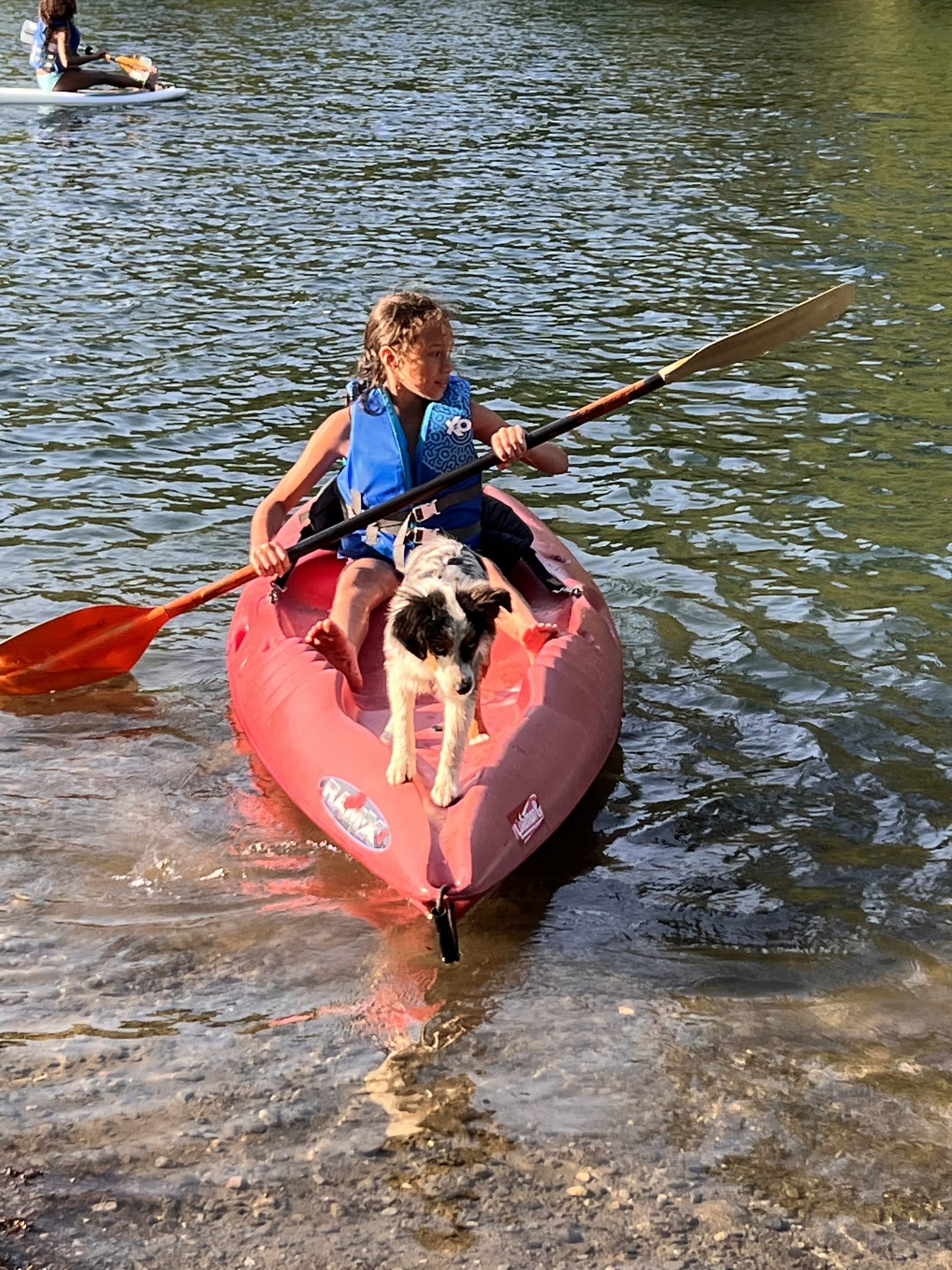
Summer is when the property does what it's built for. The four private lakes are open for swimming in designated areas (there's no lifeguard), and kayaks, canoes, paddle boards, and paddle boats are free for guests. The fishing needs no license because the water is private. On a 76-degree Easton afternoon, that is the honest pitch: a lake you don't share with a public boat launch, about 20 minutes east of the summit.
It is also our busiest season, and we'd rather say so up front. From June through August, weekends typically carry a 2-night minimum and book early, the tent and RV sites fill, and the grounds are lively rather than hushed. The tiny homes have split A/C and the cabins do not, which rarely matters at Easton's normal high but is worth knowing in a heat wave.
If you want the warm-weather version with fewer people, look at September. Easton's normal high is still 69.0°F, it gets 1.88 inches of rain for the month, and the lakes are still open. Our season-by-season guide lays out the rest of the year.
Conditions as of September 11, 2026
- Summit Bike Park 2026: tentative opening June 5, projected closing September 27. The Summit notes that season length, operating dates, and hours "are not guaranteed and are subject to change without notice."
- Snow Lake Trail: closed September 14–25, 2026, for trail work.
- Three Queens Fire closure on the Cle Elum Ranger District, including a Pacific Crest Trail closure north of Snoqualmie Pass, runs through October 31, 2026. Our fall foliage guide has the full closure list.
- Gold Creek area: closed April 1 – November 30 each year through 2028.
- Snoqualmie Tunnel: closes November 1 for the season.
Climate normals are thirty-year averages, and any single summer runs hotter or cooler. For trail and closure status, the linked agency pages are the authority, so check them before you go.