Every winter, somewhere on the climb to Snoqualmie Pass, a family sees a white hill from the freeway, pulls onto the shoulder, and unloads the sleds. It is the most common mistake in winter recreation on this corridor, and it is the one that ends with a citation, a tow bill, or worse.
The frustrating part is that it is completely unnecessary. There are four real places to put a sled on snow within about twenty minutes of our gate — three run by Washington State Parks and one by the ski area. What stops people is not a shortage of hills. It is that nobody explains the permit, and the permit is genuinely confusing.
Here is the whole thing: where to go, what each place costs, where sledding is actually prohibited, and what the injury data says about doing it safely.
The short version
- Sledding at a state Sno-Park requires a permit on the windshield. There is no free option at a state site, and the cheapest single day costs $25.
- The three sites nearest us need a seasonal permit plus a special groomed trail permit — or a one-day permit, which covers everything.
- A Discover Pass is not required on top of it between November 1 and March 31.
- Hyak has the real sledding hill. It is groomed, it is free-form, and it opens only when there is enough snow.
- Lake Easton is the quiet alternative — a designated snow play area with 30 parking spaces, which is the catch.
- The Summit's tubing park is the no-equipment option, opening November 21 for the 2026-27 season, online tickets only.
- Groomed ski tracks, highway shoulders, and ski-area slopes are not sledding terrain, and two of those three are enforced.
The permit is the part people get wrong
Washington State Parks puts it plainly: "Parking at a Sno-Park requires at least one type of permit for your vehicle." Not the hill. Not the person. The vehicle, parked.
There are three permits, and the posted prices are:
- One-day — $25 from State Parks or online, $28 from a retail vendor
- Seasonal — $50 from State Parks or online, $53 from a retail vendor
- Special Groomed Trail — $70 from State Parks or online, $73 from a retail vendor
A $3 handling fee applies to permits bought at retail locations, and permits are sold November 1 through April 30.
The trap is that third permit. Eight Sno-Parks in Washington require the special groomed trail permit in addition to the seasonal permit: Cabin Creek, Lake Easton, Chiwawa, Lake Wenatchee, Crystal Springs, Mount Spokane, Hyak, and Nason Ridge. Three of those eight are the three closest to us. So a full season of sledding at Hyak is $50 plus $70, not $50.
Unless you are only going once or twice — and most families are. The one-day permit is honored "until midnight of the date written on the permit" and covers special groomed trail areas as well, which makes $25 the correct instrument for a weekend trip by a wide margin.
One piece of genuinely good news, and it is law rather than policy. Under Substitute House Bill 1953, passed in 2019, a vehicle displaying a valid Sno-Park permit does not also need a Discover Pass from November 1 through March 31. Before that bill, day-permit holders at some locations had to display both. If you are driving to Lake Easton State Park in January, the Sno-Park permit is the only thing that goes on your dash.
Where to buy one. Online from State Parks is the route we recommend, because it works at 10 p.m. the night before. The Hyak Sno-Park office is on the official State Parks vendor list, and on this side of the pass so are Sportland Mini Mart and Motortoys in Cle Elum, with the Kittitas County Chamber of Commerce and Mountain High Sports in Ellensburg. But vendor hours are not Sno-Park hours, and a staffed office is not guaranteed on the morning you arrive with three kids in the car. Buy ahead.
The four places to sled
- Hyak Sno-Park — I-90 Exit 54, about 15 minutes west. The groomed sledding hill, and the busiest in the corridor.
- Lake Easton Sno-Park — I-90 Exit 70, about 10 minutes east. A designated snow play area, quiet, with a very small lot.
- Easton Reload Sno-Park — I-90 Exit 71, about 10 minutes east. Shared with snowmobiles, but room to just play.
- Summit Tubing Park — I-90 Exit 52, about 20 minutes west. Lift-served tubing on timed sessions.
Hyak — the actual sledding hill
This is the one people mean. The Central Cascades Winter Recreation Council, which runs State Parks' winter recreation information for this area, describes Hyak as the "Biggest, busiest sledding hill" in the corridor, with heated restrooms and free-form snow play rather than marked lanes.
The park page has the specifics: I-90 Exit 54, turn south at the off-ramp; elevation 2,560 feet; 7 miles of non-motorized trails; 150 parking spaces; hours 8:00 a.m. to dusk; no overnight parking. Grooming runs December 1 to March 31 and is performed by Lake Easton State Park, which also manages the site. Their number is 509-656-2586, and it is the right one to call for hill status.
Two warnings worth taking seriously. First, the hill is not always open — the status currently posted reads "SLED HILL IS CLOSED, IT WILL OPEN WHEN THERE IS ENOUGH SNOW," and early December is often too early. Second, State Parks notes that grooming "can be suspended during any I-90 pass closure or high avalanche danger period," and those closures happen on blue-sky days, which we cover in our guide to driving over Snoqualmie Pass in winter.
On dogs, State Parks' own pages disagree. The Sno-Park rules page states that "Dogs, except those operating in a seeing-eye capacity, are prohibited at Hyak Sno-Park," while the Hyak park page says only that dogs are not allowed on the groomed area or groomed trails. Since the sledding hill is groomed, both readings land in the same place: leave the dog at the cabin.
Lake Easton — the one locals use
Ten minutes east of us at Exit 70, in the state park's day-use area, Lake Easton Sno-Park sits at 2,200 feet — the same elevation as our property — with a designated snowplay area, 3 miles of cross-country trail, and 15 miles of snowmobile trail. State Parks' winter recreation listing calls it the relaxed option, with plenty of free-form snow play space and heated restrooms.
The catch is the lot: 30 parking spaces. That is a fifth of Hyak. On a Saturday after a storm it fills, and there is nowhere legal to overflow. Go on a weekday, go early, or go to Hyak. The rest of the park — the 5.2-mile trail loop, the fishing rules, the six months the campground is closed — is in our Lake Easton State Park guide.
Easton Reload — room to just play
Two miles south of the state park at Exit 71: elevation 2,240 feet, 50 parking spaces, 23 miles of motorized and non-motorized trail, restrooms. It is a snowmobile staging area first, so expect engine noise and expect to leave room for trailers to maneuver — but State Parks' snow play listing describes it honestly as the quiet one, with "Opportunities to just play."
It is not a designated snow play area and there is no groomed hill. It is open ground with snow on it, which for a four-year-old is the entire requirement.
The Summit Tubing Park — renting the whole experience
Lift-served tubing at the pass, with a conveyor that carries you and your tube back up the hill. The tubing park "is scheduled to open for the 2026-27 winter season on Nov. 21st," running Wednesday through Sunday plus select holidays, with night sessions at 5 p.m. and 7 p.m. Wednesday through Saturday.
Four rules that catch people out:
- "Sessions are 1 Hour 45 Minutes." This is not a day pass.
- "Tickets Must Be Purchased Online." They are not sold at the park, and sessions sell out.
- "Solo rider must be 45 inches or taller." Children 44 inches or shorter must ride with an adult.
- Guests under 18 need a parent or guardian to sign the liability release.
Parking at the pass is now its own cost. Per the Summit's parking guide, paid parking applies Fridays, Saturdays and Sundays from November 20 through April 30, plus December 18 to January 3, January 18, and February 16 — $15 for five hours, $25 all day. Tubing Lot parking is included with a tubing ticket, so that specific trip is already covered. Carpools of four or more may qualify for free parking in designated lots, first-come until the lot fills or 10:00 a.m. Unregistered vehicles "may be subject to parking fees, a parking violation notice, or vehicle relocation at the owner's expense."
Where you cannot sled
Groomed ski tracks. This is the etiquette rule that causes the most friction at Sno-Parks, and it is not negotiable. State Parks asks that "Snowshoers — walk on the sides of the trail and stay off groomed ski tracks," and the same logic applies to a sled: a set of runner marks down a classic track ruins it for every skier behind you. "Wheeled vehicles - are not permitted on any groomed trails" either.
Cabin Creek and Crystal Springs. Both are close — Cabin Creek is at Exit 63, our own exit, at 2,462 feet with 200 parking spaces, and Crystal Springs is at Exit 62 with 51 miles of trail. Neither is a sledding destination. Cabin Creek is a groomed Nordic trail system; Crystal Springs is shared with snowmobiles and carries no snow play designation at all. Park at those two to ski, not to sled.
The shoulder of I-90, pull-outs, and overpass aprons. Beyond being unsafe at freeway speed in low visibility, vehicles parked on shoulders along this stretch have blocked plows from reaching their own supply areas during storms. Park in a designated lot, with a permit, every time.
Gold Creek Pond — but it comes back on December 1. The pond at Exit 54 has been closed since May 4, 2026 for a stream and floodplain restoration project aimed at bull trout, part of the Yakima Basin Integrated Plan. The Forest Service says it "will re-open the site on December 1, 2026, for non-motorized winter recreation," with the work "anticipated to occur over the next three-to-ten-years" on that same April-to-November schedule. It is a fine beginner snowshoe loop in winter. State Parks rates the sledding there as marginal, so treat it as a walk, not a hill.
Sledding is more dangerous than it looks
This deserves two paragraphs, because almost nobody plans for it.
Researchers at the Center for Injury Research and Policy at Nationwide Children's Hospital examined a decade of national emergency-department data and published the results in the Clinical Journal of Sports Medicine: 220,488 people were treated in U.S. emergency departments for sledding-related injuries between 2008 and 2017, nearly 70% of them 19 or younger. Children were almost seven times as likely as adults to end up in an emergency department for a sledding injury, and the head was the most frequently injured body part for both groups. Rates fell over the decade, but 13,228 people were still treated in the final year studied.
The mechanism is the useful part. Collisions caused 63% of injuries, and within those, 47% involved hitting an object in the environment — a tree, a rock, a fence, a parked car. The problem is almost never the speed. It is the stopping. The same study found that children riding snow tubes and disks had a greater risk of concussion or closed-head injury than children on sleds or toboggans, because those shapes spin and cannot be steered.
What the researchers recommend: wear a fitted snow-sport or bicycle helmet; choose a steerable sled with brakes over a tube or disk; pick a hill clear of obstacles with a long flat runout that does not end at a street, a drop-off, a parking lot, or water; ride seated and feet-first; sled in daylight; never tow a sled behind a motor vehicle; and keep an adult present to check the hill and enforce the rules. A groomed Sno-Park hill solves most of the obstacle problem for you. The bike helmet already in your garage solves much of the rest, and costs nothing.
The version that needs no permit
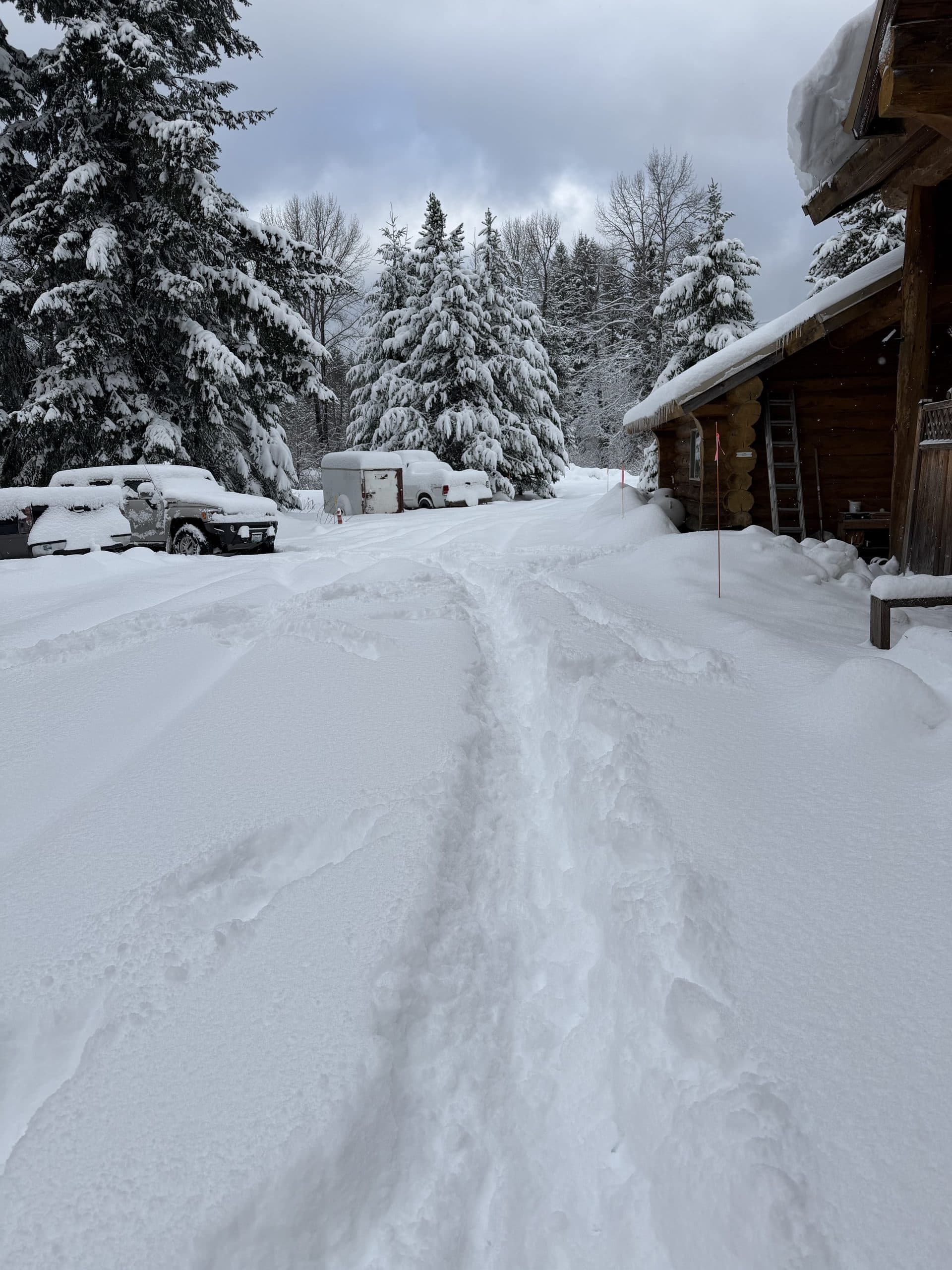
We are at 3000 U-Fish Rd off I-90 Exit 63, between Crystal Springs and Lake Easton, on 54 private acres at about 2,200 feet. Guests sled the gentle grades here, build snowmen, and walk the property on snowshoes, and none of it requires a permit, a ticket, a timed session, or a second drive over a mountain pass. The sheep, alpacas, and horses are out in the corral all winter and are, for most kids under eight, more interesting than the hill.
That is not an argument against going up to the pass. Hyak's groomed hill is better than anything we have, and the tubing conveyor is a genuinely good afternoon. It is an argument for doing both from one base: drive up for the big hill, come back to a warm cabin fifteen minutes later, and let the small people play in the yard in the morning while the adults drink coffee.
Our page on winter activities near Snoqualmie Pass covers the skiing, Nordic trails, and snowshoe routes alongside the snow play; winter cabin rentals covers what is heated and what to pack; and when Snoqualmie Pass gets snow works through thirty years of gauge data if you are trying to pick a weekend with snow actually on the ground. The full list of things to do near Easton, WA runs year-round. For current conditions, the phone is faster than any website: 425-622-2790.