Search for winter camping near Seattle and you get a list of campgrounds. What you do not get is which of them are open in February, which have had the water off since November 1, and which loop inside the park you are actually allowed to pitch a tent in.
That is the whole problem. The campgrounds in this region do not simply close — they close in pieces, by site number, on dates that differ from the park next door. Washington State Parks publishes every one of those dates on a single page that almost nobody reads before booking.
We run tent sites and 22 RV sites in Easton at I-90 Exit 63, and we do not close, so weigh our entry at the bottom accordingly. Everything above it is taken from the agencies' own schedules.
First, decide which winter trip you mean
"Winter camping near Seattle" covers two trips that share almost nothing, and the Cascade crest is the line between them.
West of the crest — Puget Sound, the Kitsap Peninsula, the islands, the foothill parks — winter means rain at 40 degrees. Few of these campgrounds get meaningful snow. The problems are mud, standing water, and a tent fly that never dries. This is the easier trip and the one with actual inventory.
East of the crest and up high — the I-90 corridor from Snoqualmie Pass to Easton, Lake Wenatchee, the volcano — winter means snow on the ground from roughly December through March and most access gated behind a permit. This is a snow-camping trip, closer in kind to mountaineering than to car camping, and the public campground inventory for it is close to zero.
Pick the trip first. Half the bad winter camping decisions in this region come from booking a snow trip with rain-trip gear.
What stays open west of the pass
All closure language below is quoted from the Washington State Parks winter schedule, which lists campground status, loop closures, and water shutoff dates park by park. State Parks' own summary of the season is that "Many parks offer first come, first served winter camping." That is the operative word — reservations thin out, walk-ups carry the winter.
- Wallace Falls, Gold Bar (about an hour northeast) — the simplest answer close to the city. "Camping is first-come, first-served all year." The catch is scale: the park lists "Two walk-in tent sites are available first-come, first-served," plus "five cabins are available by reservation" holding up to five people each, and "Two restrooms with showers are close by." Two tent sites is not a campground; it is a coin flip. The cabins are the realistic winter booking.
- Kanaskat-Palmer, Ravensdale (about 50 minutes southeast) — open through the winter on the Green River, but "Water turned off Nov. - April 1 (weather dependent)." Arrive with your own.
- Dash Point, Federal Way (about 30 minutes south) — "Upper loop closed Sept. 15 to May 15." The lower loop carries the winter. The shortest drive from the city on this list.
- Millersylvania, Olympia (about an hour south) — "Sites 1 - 7 and 226 - 248 open all year," with "Water turned off around Nov. 1 - March 31." Thirty open sites is real inventory by winter standards.
- Camano Island (about an hour and a half north) — "Upper Loop closed Sept. 30 - May 1" and "Water turned off Nov. 1 - April 1."
- Deception Pass, Oak Harbor (about two hours north) — the most-booked park in the state becomes available in winter, but read the loops: "Bowman Bay closed Oct. 1 - March 31," "Lower loop B closed Oct. 1 - March 31," "Lower loop A closed Nov. 1 - Feb 28," "Forest loop closed Nov. 1 - March 31," and "Water in the campground will be turned off in mid Nov." Quarry Pond is what is left.
- Cape Disappointment, Ilwaco (about three hours southwest) — outside the day-trip radius, but worth knowing as the state's one genuinely unqualified winter campground: "Campgrounds are open year round" and "Water and sewer are always on." Nothing else in the system reads that cleanly.
Two near Seattle that look open and are not. Saltwater State Park, Des Moines — "Campground and trailer dump are closed." And the foothill parks on the Green River carry a weather caveat rather than a date: Flaming Geyser "closes periodically in winter," Nolte "May close periodically due to weather." Do not drive to a gate on a storm weekend without calling.
The pattern to take away: a park being open and the water being on are two separate questions, and the second one is almost always no between November and April. Our guide to Washington RV parks open year-round works through the water-shutoff list in detail, including the handful of parks that keep a spigot running.
East of the pass, the corridor closes — with one exception
Along I-90 between North Bend and Ellensburg, where most Seattle-area campers actually drive, the public inventory shuts almost completely:
- Tinkham (Exit 42) and Denny Creek (Exit 47) run roughly May through September
- Kachess (Exit 62) reserves mid-June through mid-September
- Lake Easton State Park's campground (Exit 70) is closed November 1 through May 1, with the schedule noting "Sites 46 - 93 and 94 - 135 are closed Oct. 16 - May 1"
Then the exception, and it is the most useful line on the whole winter schedule for anyone camping in this corridor. Under Lake Easton, State Parks writes: "Winter camping allowed with Sno-Park permit in day-use and boat launch areas."
So the campground closes and the park does not. Ten minutes east of us at Exit 70 you can legally spend the night in winter, in the day-use and boat-launch areas, on a Sno-Park permit rather than a campsite reservation. Lake Wenatchee runs the same arrangement further north — "Once the campgrounds close, winter camping becomes available in a designated area in the South Park day-use area" — with the warning that "Campgrounds and all exterior water will be shut off, once freezing temperatures and/or snow arrives."
This is snow camping in a plowed parking lot, not a forested site with a fire ring. For a group staging an early start on the Nordic trails it is close to ideal. For a family weekend it is a parking lot.
The Sno-Park rule, and its limits
Overnight camping at a Sno-Park is legal statewide, and narrower than it sounds. WAC 352-32-030 sets it out: "Overnight camping will be allowed in approved areas within designated sno-parks in Washington state parks," then qualifies it — "when posted, provided the appropriate required sno-park permit is displayed."
Three things follow from that sentence.
Only where posted. A Sno-Park permit does not convert every Sno-Park into a campground. Hyak, the biggest and busiest in this corridor, posts no overnight parking at all. Lake Easton posts winter camping. Check the individual Sno-Park, not the rule.
The permit is not optional and not sold at the trailhead. Sno-Park permits run $25 one-day, $50 seasonal, and $70 for the Special Groomed Trail add-on, are sold November 1 through April 30, and cost $3 more at a retail vendor. Which permit you need where, and why three of the eight Special Groomed Trail parks are the three nearest this property, is in our Washington recreation passes explainer. A Discover Pass does not substitute.
Eight people per site. The same regulation caps campsites generally: "A maximum of eight people shall be permitted at a campsite overnight, unless otherwise authorized by a ranger."
If what you actually want is a day in the snow with the kids rather than a night in it, our guide to snow play and sledding near Snoqualmie Pass covers the four local hills and which permit each one takes.
Snow camping on Mount Rainier
Two and a half hours south, Mount Rainier runs the most structured winter camping program in the region, and it is gated on snow depth rather than a date. Per the park's winter camping page, camping on snow at Paradise requires at least five feet of snow on the ground; Mazama Ridge, Reflection Lakes, and other areas require at least two feet. In practice that means camping on snow generally begins around January, and the winter camping season ends May 15.
A permit is required year-round for any overnight stay in the park's backcountry. Parties of twelve or fewer get theirs in person, typically the day of the trip or the day before; groups of thirteen or more reserve through Recreation.gov once Paradise has its five feet of consolidated snow. Campfires are prohibited and camping in a vehicle is not allowed — this is a tent-on-snow trip or nothing.
The access caveat matters more than the permit. The Longmire-to-Paradise road is gated nightly and can stay closed all day in a storm, so the park's own advice is to carry supplies for extra nights. Check the park's alerts the morning you leave.
What changes once the temperature does
Four things, in the order they will affect you:
- Water is the real constraint, not cold. With the park water off from November, you are carrying everything you drink and cook with, or melting snow on a stove that is slower than you expect. Plan gallons per person per day, not liters.
- A winter water supply at the dump station is not a hookup. Several parks list one. It means jugs and a walk.
- Reservations stop being the problem and gates start. Washington's nine-month summer booking scramble simply does not apply in January. What replaces it is weather closure, and that is not something you can plan around nine months out.
- Getting there is the part people underestimate. From November 1 to April 1, chains must be carried over Snoqualmie Pass regardless of conditions, and WSDOT closes the summit outright for avalanche control. Our guide to driving over Snoqualmie Pass in winter covers the chain rules, the closure patterns, and what the signs actually require.
The short version
- Closest true year-round camping to Seattle: Wallace Falls, first-come first-served all year — but two tent sites, so treat the five cabins as the real booking
- Most open sites west of the crest: Millersylvania, sites 1-7 and 226-248 all year, water off November 1 to March 31
- Shortest drive: Dash Point lower loop, upper loop closed September 15 to May 15
- Looks open, is closed: Saltwater State Park
- The I-90 exception: Lake Easton day-use and boat-launch areas, winter camping on a Sno-Park permit while the campground is closed
- Most structured snow camping: Mount Rainier, five feet of snow at Paradise, two feet elsewhere, permit year-round, season ends May 15
- Universal rule: assume the water is off from November 1 and arrive carrying your own
Where we fit, honestly
We are at I-90 Exit 63 in Easton, about 80 minutes from Seattle, on 54 private acres at roughly 2,200 feet — the same elevation as the Lake Easton Sno-Park down the road. We do not close. Tent sites, 22 full-hookup RV sites, shared restrooms and two full-size showers, and no pass or permit required to park.
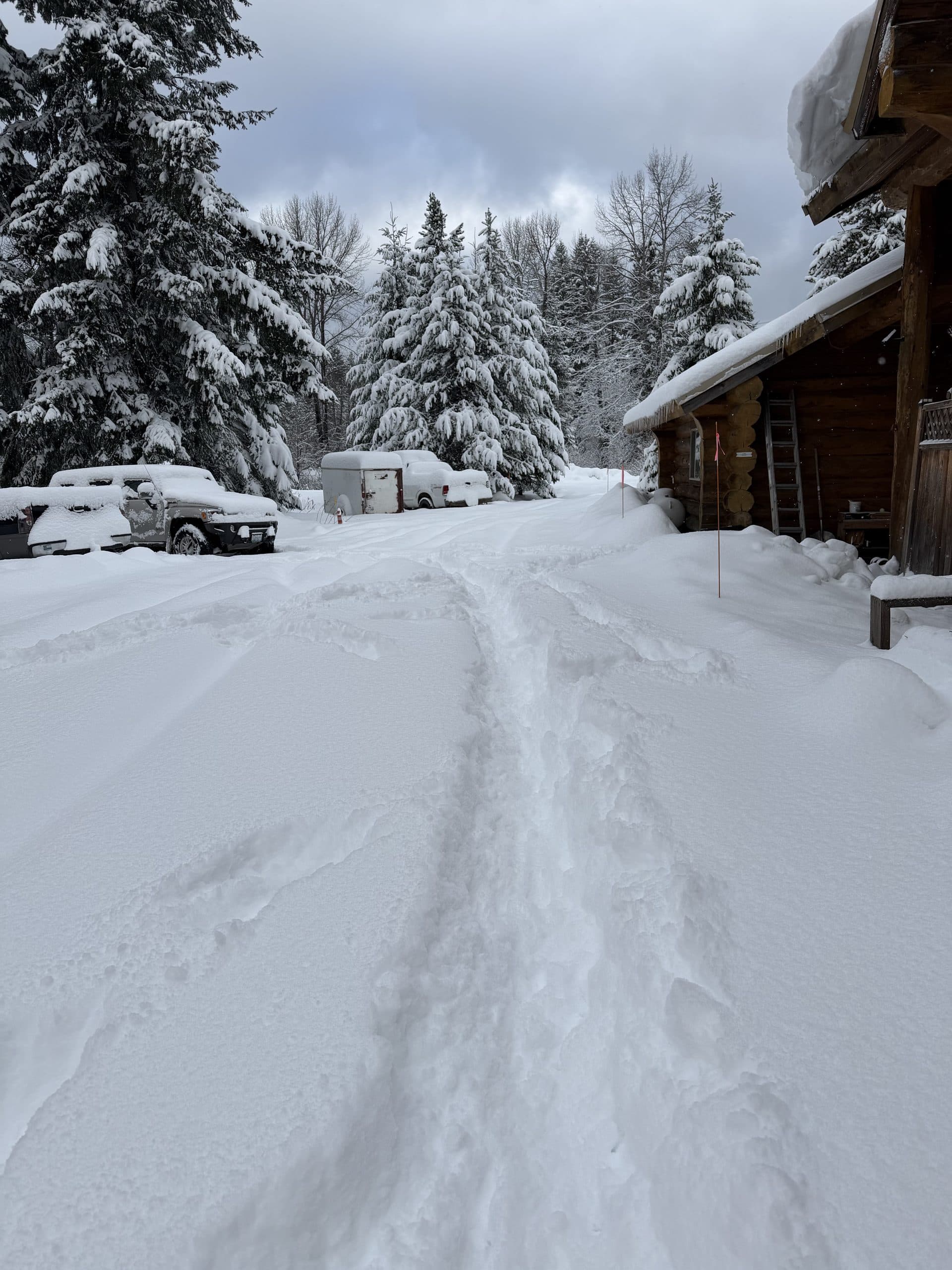
The honest version: tent camping here in January is still winter camping. It is snow on the ground, a cold night, and water you will want in the truck. What you get that the public campgrounds in this corridor cannot offer between November and May is simply that we are open, the showers are hot, and there is availability on a Saturday.
And the honest limits. The four private lakes ice at the edges, so the kayaks, canoes, paddle boards, and paddle boats come out of service and the fishing slows down — the free water equipment that defines a summer stay here is a summer thing. What stays: the sheep, alpacas, and horses are out in the corral all winter, and the hiking trails on the property are walkable in boots.
Most people who come here in winter do not pitch a tent. They take a cabin, which is the comparison worth making rather than pretending otherwise — every unit on the property is hard-sided and heated, and our winter cabin rentals page covers the per-unit heat and bathroom details. Rates and availability are at 425-622-2790 or through booking, and what there is to do once you arrive is on our winter activities page.
Conditions as of October 2026
Loop closures, water shutoff windows, site numbers, and the Lake Easton and Lake Wenatchee winter camping provisions above were taken from Washington State Parks' published winter schedule on the date of this post, and the Mount Rainier thresholds from the park's winter camping page. State Parks revises the schedule seasonally and a hard freeze can shut water off early at a park that normally keeps it on. National forest campground seasons shift with snowpack. Confirm with the individual park or ranger district before you drive.