
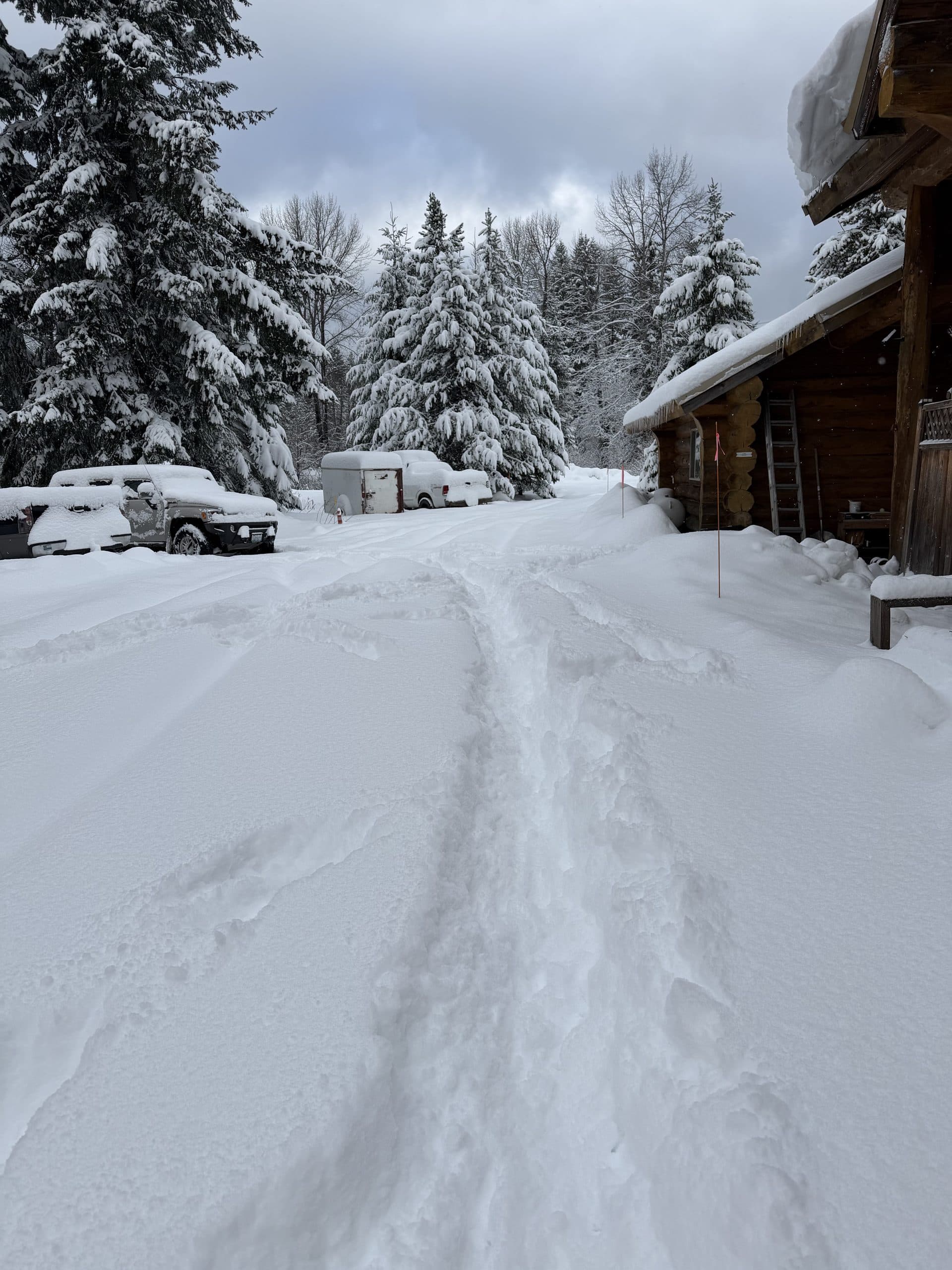
Almost all winter RV advice on the internet is actually winterizing advice: blow out the lines, pour pink antifreeze down the traps, pull the batteries, park it until April. That is advice for storing an RV.
This is about the opposite problem — living in one, plugged in, while it's freezing outside. A winterized rig has no water in it anywhere. A rig you are camping in has water in it everywhere, and the only question that matters is which part freezes first.
We run 22 RV sites at I-90 Exit 63 in Easton at about 2,200 feet, and we keep water on at the sites all winter, so weigh our entry here accordingly.
Things freeze in a predictable order
Not all at once, and not evenly. Roughly outside-in, smallest volume first:
- The city water hose. A thin tube of water, no insulation, fully exposed on all sides. This is the first casualty by a wide margin, and it can freeze in a few hours at temperatures where nothing else on the rig is in any danger.
- The fittings on either end — the park spigot, your pressure regulator, the inlet on the side of the rig. Small metal parts lose heat fast.
- Dump valves and the sewer hose, if you leave one connected. Standing water sitting in a low spot in the hose or behind a gate valve.
- Low-point drains and anything plumbed through an unheated pass-through or storage bay.
- Holding tanks. Large volume, usually tucked in the belly. Slow to freeze, and slower to thaw.
- The plumbing inside the cabin. Last, because it lives in the heated space. If this freezes, something upstream already failed — the furnace quit, or you ran out of propane.
The useful conclusion from that list: the thing most likely to end your weekend is the cheapest item on it. And the fix is a decision you make before you arrive, not at two in the morning in a headlamp.
The water hookup: hose, or tank?
There are two strategies. Pick one on purpose rather than drifting into the first one.
Stay on the hose. This works only with a heated drinking-water hose — self-regulating heat tape bonded along a potable hose, plugged into shore power — and only if you insulate both ends too. The failure point is almost never the middle of the hose. It is the bare coupling at the spigot, the regulator, and the sag of hose lying in the snow where the heat tape is working against an infinite heat sink.
Run off your fresh tank. Fill during the warm part of the day, disconnect, drain the hose, coil it and put it inside. Your fresh tank sits in the insulated envelope and your furnace is already heating it. The cost is capacity — you are now metering showers and dishes against however many gallons you carry.
The honest comparison: the hose is more comfortable when it works, and it fails by leaving you without water at 6 a.m. The tank has no such failure mode — it just runs out, slowly, with warning. For a weekend in a cold snap, most people are better served by the second one.
No sewer at the site is an advantage in winter
This one surprises people, so here is the reasoning rather than just the claim. At a full-hookup park in summer, almost everyone leaves the sewer hose connected for the whole stay. In freezing weather that habit is the classic plumbing failure: water stands in a low spot in the flexible hose and freezes solid, or the gate valve freezes shut with a full tank behind it.
Our sites are electric and water with a dump station on the property — there is no sewer hookup at the individual sites. In July that is a minor inconvenience and we say so plainly. In January it quietly removes that failure from the board, because there is no hose out there to freeze. Keep both valves closed, let the tanks fill, and make one trip to the dump station on the warmest afternoon of your stay.
The timing is the part to plan. Do not let a nearly-full black tank sit through a long freeze on the theory that you will empty it at 7 a.m. on departure morning — if the valve is frozen, you are leaving with it full.
The furnace is your plumbing's heater. A space heater is not.
This is the single most expensive thing to get wrong, and it is also the most common.
An electric space heater warms the air in the cabin. The propane furnace warms the air and pushes heat into the places your plumbing actually lives. Keystone describes its cold-weather package as a "Fully heated & enclosed underbelly with Astrofoil insulation" and states the mechanism in one sentence: "Ducted heat protects plumbing systems when temperatures dip." Some manufacturers add electric pads on top of that — Keystone says "All Outback models have 12V heating pad protection for fresh and waste water tanks to prevent them from freezing."
So the rule is: in a hard freeze, run the furnace even when the space heater is holding the cabin at a comfortable temperature. Your thermostat is reading cabin air. Your water lines are not in the cabin.
The caveat on that same manufacturer page is worth quoting too, because very few marketing pages include one: "all RVs are susceptible to freezing water lines and tanks," and "Use caution when camping in below-freezing temperatures." That is an RV maker saying a cold-weather package reduces the risk rather than eliminating it. Believe them.
Three practical corollaries:
- Open the cabinet doors under sinks and anywhere else plumbing runs against an exterior wall, so cabin heat can reach the lines.
- Do not block the floor registers with duffel bags and boots. Ducted heat that cannot get out of the duct is not protecting anything.
- If your rig has no enclosed, heated underbelly, you are on the fresh-tank strategy by default, and you should know where your low-point drains are before it gets dark.
The 30-amp math
The reason you cannot simply heat the whole thing with electricity is arithmetic, and it is worth doing once:
- 30-amp service is a single 120-volt leg at 30 amps — 3,600 watts, total, for everything.
- 50-amp service is two 120-volt legs at 50 amps each — 12,000 watts.
- A 1,500-watt space heater draws 12.5 amps.
On 30 amps, one space heater is already more than 40% of your entire supply. Add an electric water heater element, which is in the same power class as a space heater, plus the converter charging your batteries and a microwave or coffee maker, and the second space heater is what trips the pedestal breaker — usually when it is coldest and everything is running at once.
Our sites are wired for both 30 and 50 amp. On 50 amps you can run two heaters and stop thinking about it. On 30 amps, plan on one heater plus the propane furnace. Which is the second argument for the furnace: it burns propane and draws only the small 12-volt blower, so nearly all of its output lands outside your amp budget.
How long the propane actually lasts
You can work this out before you leave, with two numbers.
The U.S. Energy Information Administration puts propane at 91,452 Btu per gallon. Suburban's ducted SF-Q series furnaces are rated from 20,000 to 40,000 Btu per hour — the data plate on your own furnace has the number that applies to you.
A furnace does not run continuously; it cycles against the thermostat. Assume a 50% duty cycle on a cold night and the math is:
- A 20,000 Btu/hr furnace averages 10,000 Btu/hr — roughly 9 hours per gallon.
- A 40,000 Btu/hr furnace averages 20,000 Btu/hr — roughly 4.5 hours per gallon.
Then round down, because the duty cycle climbs toward 100% as the temperature drops and as the insulation gets thinner, and because your water heater, refrigerator and stove are drawing on the same bottles.
The operational version of that arithmetic: in a genuine cold snap, a pair of standard cylinders is a few days, not a week. Know where you intend to refill before you need to, and call ahead rather than assuming January hours match July hours. Cle Elum, about fifteen minutes east on I-90, is the nearest full-service town to us.
Batteries get weaker, and lithium gets picky
Two cold-weather problems that often get discussed as one. The first is capacity: every chemistry delivers less of its rated amp-hours as it gets cold. That is a nuisance.
The second is a hard rule, and it applies specifically to lithium. Battle Born states that LiFePO4 batteries "should not be charged below approximately 25°F unless they are equipped with internal heating", while "in most cases, they can discharge down to approximately -4°F," and that the battery management system "automatically blocks charging when temperatures fall outside safe limits."
Read the asymmetry in those two numbers, because it is the part that catches people out. A cold lithium bank will cheerfully run your furnace blower all night and then refuse to accept a charge in the morning. That refusal is the BMS protecting the cells, not a fault — but if your batteries live in an unheated front compartment and your plan depends on recharging them, you want either a model with internal heating or the bank moved somewhere warm. On shore power this matters far less than it does boondocking, which is the quiet argument for taking a hookup site in winter.
Condensation is the problem nobody plans for
Put four people, a propane burner and a pile of wet outerwear inside a sealed box at 15°F and the water has to go somewhere. It condenses on the coldest surfaces available: window glass, aluminum frames, the corners of slide-outs, the back wall of cabinets on the exterior side. The instinct — seal everything up and keep the heat in — makes it worse. What works:
- Run the roof vent fan while cooking and showering, and leave a vent cracked overnight.
- Dry boots and coats somewhere other than a closed closet. Our shared bathhouse has 3 bathrooms and 2 full-size showers, which is the warmer place to deal with wet gear.
- Wipe the window sills in the morning. Two minutes, and it is the difference between a damp weekend and mildew in the spring.
One safety note belongs here. A propane furnace is vented, so its combustion moisture goes outside. Unvented portable propane heaters put every bit of their water vapor into the cabin along with a carbon monoxide risk. Test the CO and propane alarms before you leave home — CO alarms have an expiration date printed on the back, and plenty of them are past it.
Getting here is its own chapter
From November 1 to April 1, chains must be carried over Snoqualmie Pass regardless of conditions, and WSDOT closes the summit outright for avalanche control. Towing matters here: vehicles over 10,000 pounds must carry at least two extra tire chains, and a three-quarter-ton truck under a fifth wheel clears that threshold easily. Our guide to driving over Snoqualmie Pass in winter covers the sign levels, what the chain rules actually require, and how the closures tend to run.
One geographic note in your favor: Easton is at Exit 63, on the east side of the summit. If you are coming from Ellensburg, Yakima or Spokane, you never cross the pass at all.
Where we fit
We are at I-90 Exit 63 in Easton on 54 private acres, and we do not close. 22 back-in sites, 30/50-amp electric and water at every site, a dump station on the property, no sewer at the individual sites, most sites taking rigs up to 40 feet — call 425-622-2790 if you are longer than that. Shared facilities are 3 bathrooms and 2 full-size showers.
The honest version of the winter pitch: the water is on, the sites are available, and midweek in January you will have most of the place to yourself. What you are not getting is summer. The four private lakes ice at the edges, so the kayaks, canoes, paddle boards and paddle boats come out of service and the fishing slows down. What stays is the sheep, the alpacas and the horses, out in the corral all winter, and the property trails, walkable in boots.
If the propane arithmetic has talked you out of running a rig through a mountain winter, that is a reasonable conclusion and we have an answer for it: every unit on the property is hard-sided and heated, and the winter cabin rentals page covers the per-unit heat and bathroom details. What there is to do once you get here is on the winter activities page.
The short version
- First thing to freeze, every time: the city water hose. Heated hose with both ends insulated, or run off the fresh tank.
- Safest water strategy for a weekend: fill in daylight, disconnect, store the hose inside.
- Never leave a sewer hose connected in a freeze. Valves closed, dump once on the warmest afternoon.
- Run the furnace, not just the space heater — ducted furnace heat is what protects the underbelly plumbing, and the thermostat only reads cabin air.
- 30-amp service is 3,600 watts total. One 1,500-watt heater plus the furnace. Two heaters needs 50 amps.
- Propane: 91,452 Btu per gallon against a 20,000–40,000 Btu/hr furnace at roughly 50% duty — about 9 hours per gallon at the small end, 4.5 at the large end. Round down.
- Lithium batteries: will discharge to about -4°F but should not be charged below about 25°F without internal heating.
- Condensation, not cold, is what ruins the interior. Vent while cooking, crack a vent at night.
- Chains must be carried over Snoqualmie Pass November 1 to April 1, conditions or not.
Looking for somewhere with the water still on rather than how to run the rig once you get there? Our guide to RV parks open year-round in Washington goes park by park, and winter camping near Seattle covers the same question for tents. In the other direction on the calendar, RV camping near Seattle sorts the corridor by rig length and hookup class.
Conditions as of November 2026
The furnace output range, the underbelly and tank-heating descriptions, the propane energy content and the lithium temperature limits above were taken from Airxcel/Suburban, Keystone, the U.S. Energy Information Administration and Battle Born Batteries on the date of this post. Manufacturer specifications change by model year, and the figures that matter most to you — furnace Btu rating, tank capacities, whether your underbelly is actually heated — are on your own rig's data plates and in its owner's manual, not in a general guide. The electrical and propane calculations here are arithmetic from those published figures, shown so you can redo them with your own numbers. Chain requirements and pass closures are set by WSDOT and change through the season; check before you tow.