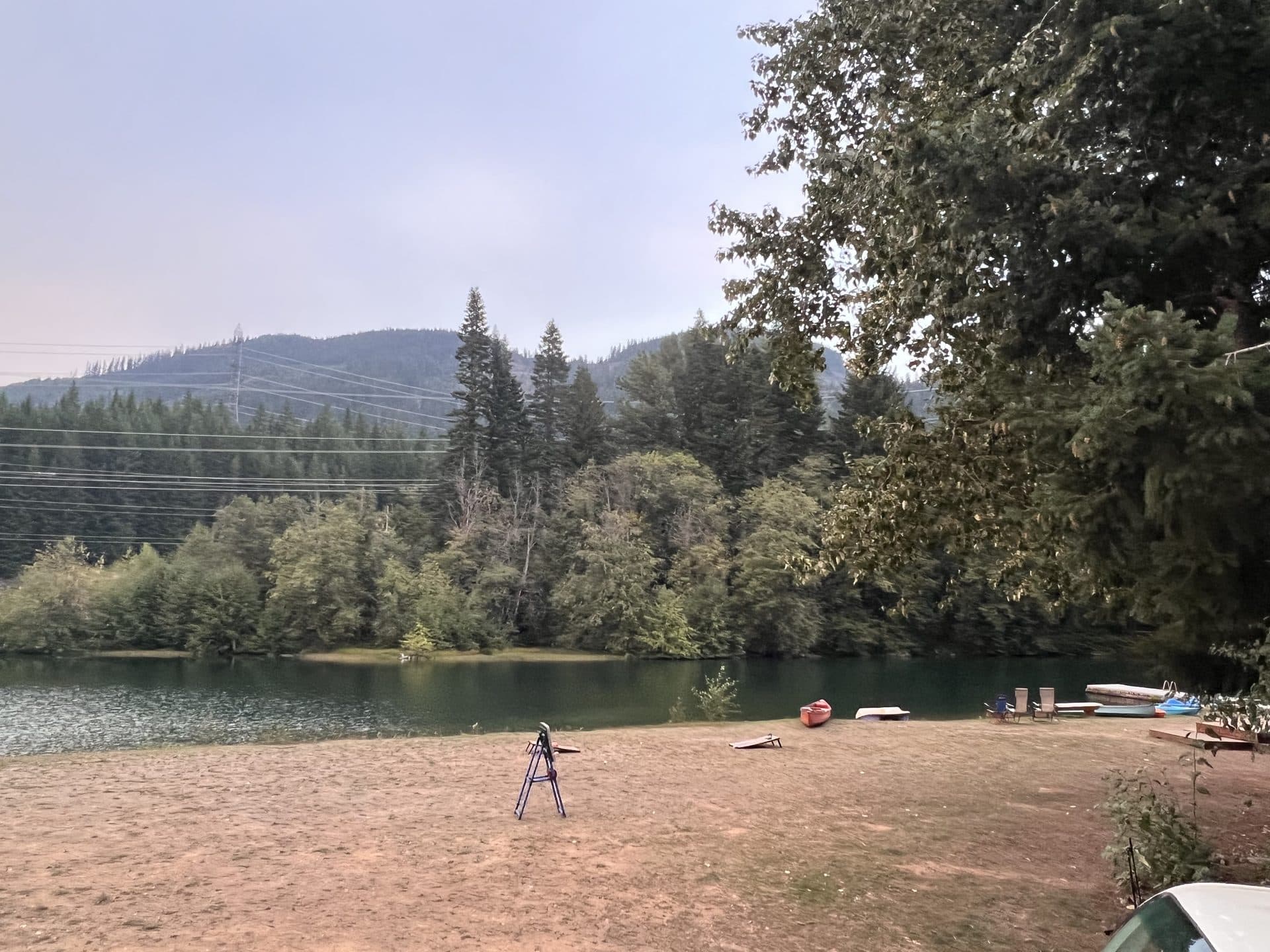
Kachess is the big water around here. Our four lakes are ponds by comparison, Lake Easton is a shallow 200-acre reservoir beside the freeway, and then there is Kachess: 4,377 acres, 430 feet deep, ringed by forest, one interchange west of us at I-90 Exit 62.
It is also the lake most likely to disappoint someone who shows up in late August with a boat on the trailer, because Kachess is not really a lake. It is an irrigation reservoir that gets drained every summer, and the boat launch goes dry before the school year starts.
Here is the honest picture — the camping, the day use, the fishing rules, and what the 2026 fire closure still covers — with the figures taken from the agencies that publish them.
Kachess in orientation
- Where: I-90 Exit 62, then about 5.5 miles up Kachess Lake Road
- From our gate: about 20 minutes
- Size: 4,377.80 acres, up to 430 feet deep, at 2,254 feet elevation
- Campground season: early June to mid-September — about 14 weeks
- Day use: $11 per vehicle per day, and your federal recreation pass does not cover it
- Boat launch: usually gone by August on the irrigation drawdown
- Fishing: year-round season, but bull trout are closed and must be released
- Right now: the campground season is over, and part of the fire closure is still in force
The lake, in one paragraph
WDFW lists Kachess Lake at "4377.80 ac." in Kittitas County — roughly twenty-one times the surface of Lake Easton down the road. Wikipedia's entry puts the surface elevation at "2,254 ft (687 m)" with a maximum depth of "430 ft (130 m)," which is the number that explains the color of the water. A 115-foot earthfill dam built in 1912 controls it, holding an active capacity of "239,000 acre⋅ft," and "the upper part of the lake, north of a narrows, is called Little Kachess Lake."
One more detail worth carrying up the hill: the name. Kachess means "more fish," in deliberate contrast to Keechelus — the next reservoir west, whose name means "few fish."
The drawdown is the thing to understand first
Everything else about Kachess follows from this. It is a working part of Reclamation's Yakima Project, and by late summer the water that was holding your boat is irrigating orchards 100 miles downstream.
WDFW states it without hedging: "there is no late summer boat launching facility available due to excessive reservoir drawdown." That is not a bad-year caveat, it is the normal annual pattern. In 2026 the Recreation.gov listing for the campground posted the date outright — "Due to low water levels in the lake the boat launch will close on Saturday, 8/01/2026" — alongside the standing note that "Water levels in Kachess Lake and Little Kachess Lake vary during the summer."
August 1. On a campground season that runs to mid-September.
The mechanism is published too. Every year Reclamation runs what it calls the flip-flop, an "annual 'flip-flop' operation, beginning in mid-August, to aid in successful spawning and incubation of chinook salmon eggs and to improve winter reservoir storage," in which flows out of Keechelus and Cle Elum are cut back while flows from Kachess and Rimrock increase (Reclamation, August 2024). Kachess is the reservoir that gets spent so the upper Yakima can run low and clear for salmon — the same operation we describe from the angler's side in our guide to Yakima River fishing near Easton.
So: if the trip depends on launching a boat, go in June or early July. If you are bringing kayaks, a paddleboard, or a swimsuit, the shrinking shoreline matters much less, and WDFW rates shoreline access here as "Good."
The campground
Kachess Campground is a Forest Service site at 8000 Lake Kachess Road, Easton WA, at 2,250 feet "on the northwest shore of Kachess Lake with Little Kachess Lake to the immediate north." It is the largest public campground with an Easton address, and it is nothing like a private park.
The Forest Service describes "over 100 campsites and one group campsite (by reservation only)"; the Recreation.gov listing counts 150 sites with 106 reservable single-family sites, the rest first-come, first-served. Either way it is big.
What it has: two boat launches — the south one paved, the north one maintained gravel — a picnic area, a swimming area, potable water, and flush toilets. What it does not have: "There are no electric hookups." No water or sewer at sites either, and no dump station listed.
Season is "Early June - Mid September." Fees, per the Forest Service: $27 a night for a single site, $54 for a double, $158 for the group site, and $11 for an additional vehicle. A senior or access pass takes 50% off a single site or day use, but not off double or group sites.
For how this stacks up against the rest of the county's public campgrounds by elevation and season, see our guide to camping in Kittitas County; for the honest cost-and-hookup comparison against a private park like ours, RV park vs. state park camping in Washington and our roundup of the best camping near Seattle both put Kachess side by side with the alternatives.
Day use: the $11 rule that catches pass holders out
This one generates genuine irritation at the fee station, so it is worth stating plainly. Day use at Kachess is $11 per vehicle per day, and the Forest Service is explicit that "Recreation Passes are not accepted for day use fees."
Your Northwest Forest Pass does not cover it. Your America the Beautiful annual pass does not cover it. A Discover Pass certainly does not — that is a state pass, and this is federal ground. Bring $11.
The other thing to plan around is parking. The Forest Service's own warning: "On busy summer weekends, the boat launch and day use parking areas fill up fast." Exit 62 is 80 minutes from Seattle, which means Kachess absorbs a lot of Saturday traffic for a place with one road in.
Fishing at Kachess
This is the most rule-bound water near us, and the rules differ from Lake Easton's in ways that trip people up. Per WDFW, Kachess holds bull trout, burbot, cutthroat trout, kokanee, pygmy whitefish, rainbow trout, and westslope cutthroat trout, with a year-round open season.
The specifics:
- Bull trout are closed. WDFW: "The lake is closed to fishing for bull trout; please carefully release any bull trout that are inadvertently hooked."
- "There is a 10-fish catch limit for kokanee in addition to a 2-fish, 14-inch minimum size trout daily limit."
- "Two-pole fishing is NOT allowed" — the opposite of Lake Easton one exit east, where it is. Same county, same corridor, different rule.
- Shoreline access is rated "Good," which matters more here than at most reservoirs once the launch is dry.
A Washington license is required, as on all public water. Our guide to fishing near Easton covers Kachess alongside Keechelus, Lake Easton, and the Yakima, and if you are wondering why our own lakes need no license, that is a private-water determination that stops at our property line.
What the fire closure still covers
The Three Queens Fire reshaped access around this lake in 2026, and the closure has been shrinking rather than lifted. The current order — number 06-17-03-2026-45 — "is effective October 1, 2026 and will remain in effect through October 31, 2026, unless rescinded sooner," and the reduction restored access to the north end of Kachess Lake, the north end of Cle Elum Lake, and Keechelus Ridge east of I-90.
Still closed under that order: Owhi Campground and Owhi Boat Launch, and the Mineral Creek, Rachel Lake, and Pete Lake trailheads. On the trail side, Little Kachess Trail 1312, Rachel Lake Trail 1313, Mineral Creek Trail 1331, Lake Lillian Trail 1332, Gold Creek Valley Trail 1314, and Kachess Ridge Trail 1315 north of Knox Creek are all named, along with forest roads including 4930.
Two cautions. First, the Kachess Campground page was still displaying a "Site Closed — 2026 Three Queens Fire" banner well after the reduction, so the site pages lag the orders; the closure order and its map are the controlling documents. Second, that order expires at the end of October and fire closures in this district change between seasons — check the forest's alerts page for the weekend you are actually going, not this page. We track the wilderness side of the same closure in our Alpine Lakes Wilderness guide.
As of mid-October the campground question is moot anyway: the season ended in September, and it will not reopen until June.
Kachess, Lake Easton, or here
Worth being direct, since all three are within 20 minutes of each other.
Kachess is the one to pick for scale and depth — a big, cold, genuinely beautiful mountain reservoir with a cheap forest campsite on it and no hookups, open about 14 weeks a year, with a boat launch that may already be dry when you arrive. Lake Easton State Park is smaller and shallower with stumps near the surface and a 10-horsepower limit, but it has a paved launch into April, hookup sites, and a 5.2-mile trail loop. We are a private 54-acre property, open year-round, where the four lakes are small, warm, stocked, and need no fishing license — and where nothing gets drained in August.
If you want the forest campground experience, take it. We say the same thing in every comparison we write: a national forest site on a big lake costs a fraction of a private site, and nothing we have competes with 430 feet of water.
What we are good for is the other three-quarters of the year, and the nights when Kachess is full. We are at 3000 U-Fish Rd off I-90 Exit 63 — one interchange east of the Kachess turnoff — with cabins, a 14-person lodge, 22 full-hookup RV sites, and tent camping on 54 private acres, about 80 minutes from Seattle. The hike up to the old lookout site above Kachess is covered in our guide to hiking trails near Easton, and the rest of what there is to do nearby is on our activities page.