Gold Creek Pond is the easiest walk at Snoqualmie Pass and the only paved, barrier-free loop for miles. It is also closed for eight months of every year, and will be for years to come.
That second sentence is missing from most of what you will read about it. Search the name today and you will still find guides describing a summer stroll with a stroller, trip reports from the pavement, and photo galleries of blue water in August. The walk those pages describe is not currently available, and the plan is for it not to come back in its present form.
Here is what the agencies actually say, and what is left — which turns out to be a genuinely good winter outing, with one permit detail that saves you seventy dollars.
The closure, in the order's own words
The governing document is Gold Creek Area Closure order 06-17-03-2026-12, issued by the Cle Elum Ranger District of the Okanogan-Wenatchee National Forest. Two dates matter in it, and they are routinely confused.
The order runs a long time: "This Order is effective June 23, 2026, through June 22, 2028, unless rescinded sooner."
The closure inside it is seasonal. The order closes the area "seasonally, April 1 – November 30, for the duration of this Order."
So the pond is not shut permanently. It is shut for the eight months most people would want to walk it, every year, for as long as the order stands.
Three things are named as closed: the Gold Creek Pond Day Use Area, Gold Creek Trail #1314, and the forest road spur that reaches the parking lot. That trail number is worth separating out, because there are two different trails here. #1314 is the Gold Creek valley trail running north up the basin. The paved loop around the water is a different route — the Forest Service lists it as Gold Creek Pond Trail 1250 and describes it as "a barrier-free interpretive trail that loops around the pond." The seasonal closure takes both, along with the lot you would park in.
The important sentence for anyone planning a trip is the reason the dates were drawn where they were. The Forest Service set the April-to-November window, in its words, "to allow for winter non-motorized recreation, pending on-site public safety conditions." The closure was built around keeping winter access open.
One caution if you check status yourself: the two forests publish different end years. The Okanogan-Wenatchee alert ties the seasonal closure to an order expiring in 2028. The Mt. Baker-Snoqualmie recreation page for the same site says "Gold Creek Area will close seasonally, April 1 – November 30 through 2027." WTA says through 2028. The site sits near the two forests' shared boundary at the crest, which is why its status information is scattered across pages that do not agree. Treat 2028 as the planning figure and re-check before you drive.
What is left: December 1 to March 31
For the 2026 season the Forest Service was specific. The closure "went into effect on May 4, 2026," and "The Forest Service will re-open the site on December 1, 2026, for non-motorized winter recreation."
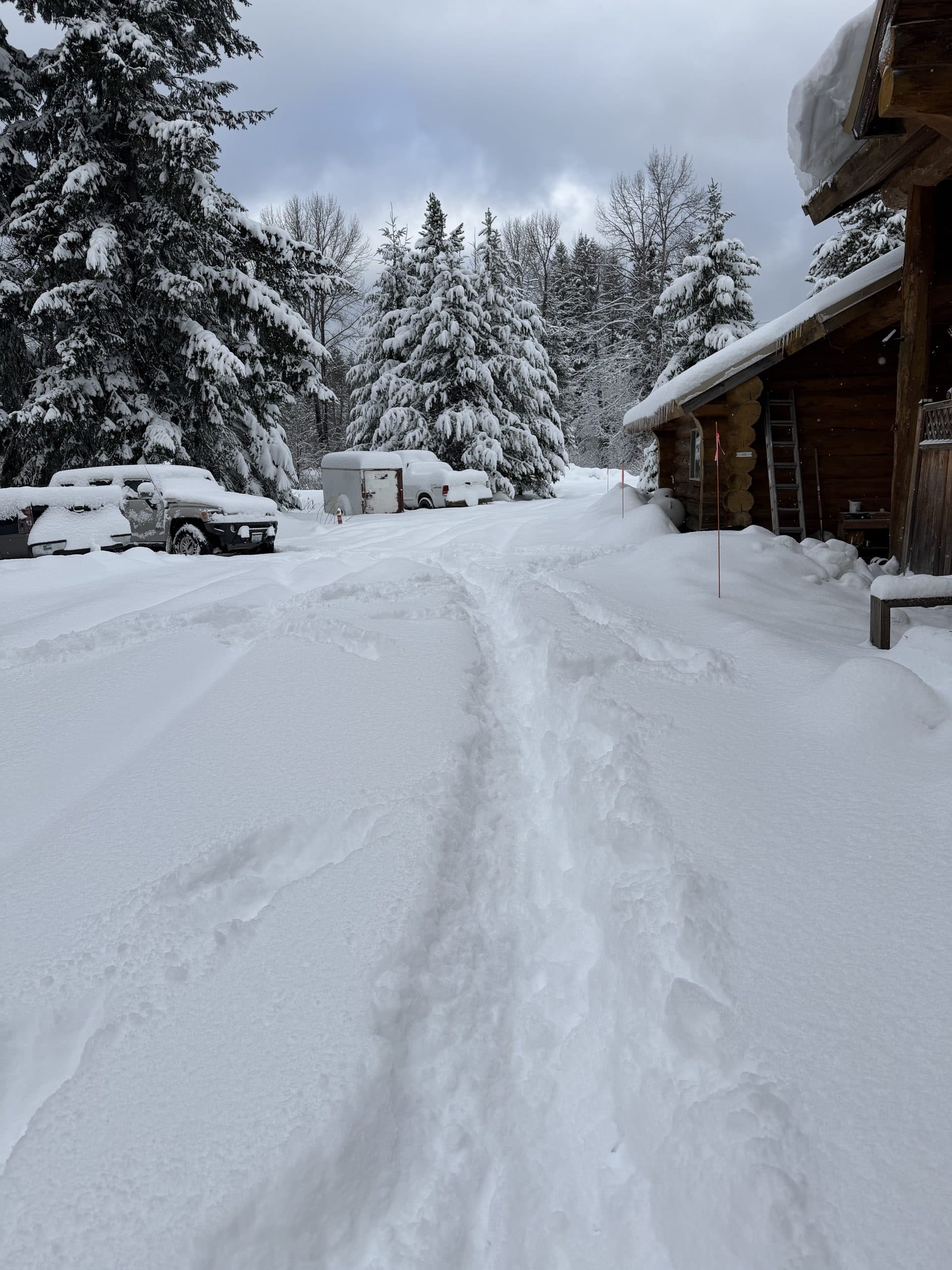
The winter outing is not the summer one. You cannot drive to the pond, because Forest Road 142 — the spur into the parking lot — is not plowed. So the walk gets longer and starts somewhere else:
- Distance: 2.8 miles round trip, per WTA's winter listing, against 1.0 mile in summer
- Elevation gain: 10 feet. The summer figure is also 10 feet — this is flat ground in both seasons
- Site elevation: 2,560 feet per the Forest Service and Washington State Parks; WTA lists the high point as 3,000 feet
- Where you park: along Forest Road 4832, inside Gold Creek Sno-Park, about a mile east of the Exit 54 interchange on the north side of the freeway
- The road walk: about 0.3 mile from FR 4832 to the Gold Creek Pond parking turnoff, then the loop
Flat, short, scenic, and genuinely beginner-friendly on snowshoes — which is why it is the route nearly everyone recommends for a first time out, including our own winter activities guide.
The permit detail that saves you $70
This is the part worth reading twice, because two Sno-Parks sit at the same freeway exit and they do not cost the same.
Gold Creek Sno-Park needs the basic Sno-Park permit and nothing else. The Forest Service states it flatly: "A Special Groomed Trail Sticker is NOT required at Gold Creek Sno-Park." The permit itself is required December 1 through March 31.
Hyak Sno-Park, across the interchange, is one of the eight that does require it. Washington State Parks lists the Special Groomed Trail permit — $70, charged in addition to a seasonal permit — at Cabin Creek, Lake Easton, Chiwawa, Lake Wenatchee, Crystal Springs, Mount Spokane, Hyak and Nason Ridge. Hyak is the 7-mile groomed non-motorized network; Gold Creek is ungroomed on its non-motorized side.
Posted permit prices are $25 one-day and $50 seasonal, sold online November 1 through April 30. Buy before you leave — the Forest Service warns that no vendors are located at Snoqualmie Pass, and you cannot pay at the trailhead. Which pass covers which lot in this corridor is the whole subject of our recreation passes explainer; Gold Creek is the cheap one.
The summer requirement is different again, and currently academic: the day-use area takes a Northwest Forest Pass or an interagency pass, posted at $5 per vehicle per day or $30 annually.
Snowmobiles, private property, and where to turn around
Gold Creek Sno-Park is a shared site, and the sharing is lopsided. Washington State Parks lists "1.7 miles of snowshoeing and 23 miles of motorized trails." Groomed snowmobile routes leave the same parking area and follow FR 4832 toward Keechelus Ridge.
In the valley itself the rule is narrower than people assume: "Snowmobile use is limited to Ski Tur Valley residents." The route up the basin passes private homes in Ski-Tur Valley, so staying on the road and reading the signs is not optional.
Two safety points, both from the agencies rather than from us:
- Avalanche terrain starts where the valley narrows. The Forest Service notes slide paths on both sides of Gold Creek valley and suggests staying mid-valley or following the creek, with a turnaround near the 3.5-mile point. WTA is blunter: "The Lower Gold Creek Basin narrows to a tight valley where avalanches are prone." The pond loop is not the problem; continuing up-valley is a different decision requiring different skills.
- The access road is the other hazard. WTA calls it "narrow and often icy," and the lot gets crowded on weekends and holidays. Getting there is its own exercise — see driving over Snoqualmie Pass in winter.
There is no potable water at the site, and restroom service is seasonal.
Why it is closed: the pond is the thing being fixed
Most closures protect a place from visitors. This one is different, and the difference explains why the dates will not loosen soon.
The pond is not natural. Forterra records that the state "dug massive pits throughout the valley to extract the gravel needed to build the road" in 1929, with another 750,000 cubic yards removed in the 1970s. WTA's version: "It's hard to believe, but in the 1970s and early 1980s this was a gravel pit created and used for building I-90." When the digging stopped, the pit was left to fill with water drawn out of Gold Creek rather than restored to wetland — and that, per Forterra, is the trouble: the "unnatural construction intensifies the creek's annual dry period."
The consequence is a fish-passage failure. The U.S. Fish and Wildlife Service states that "Seasonal decreases in stream flow create a barrier to fish passage" — spawning bull trout cannot move upstream, and juveniles strand in disconnected pools. The stated objective is to "restore old gravel borrow pits to riparian and forested wetland to improve stream flow," across 47 acres, recharging groundwater in the process.
The scale explains the timeline. Kittitas Conservation Trust leads the work, with the Yakama Nation, the Forest Service, the Washington Department of Fish and Wildlife and other partners. Federal investment to date is $8 million and non-federal $3 million, against total restoration costs of $48 million — leaving roughly a $30 million gap, with only the instream work currently funded. The Forest Service's own estimate: "Restoration work is anticipated to occur over the next three-to-ten-years."
Read that objective again and the honest conclusion follows. The deep blue pond is the artifact, and turning those pits back into wetland is the point of the project. The barrier-free pavement around open water that made this the most accessible walk at the pass is not a permanent feature. Winter visits over the next few seasons are a chance to see a place in the middle of being undone on purpose.
What to do instead, April through November
Because this one is closed for the entire warm season, the useful answer is where else to go:
- Flat and easy, with no parking pass at all: the old rail grade through our town — the Palouse to Cascades Trail at Easton
- A short lake walk with real restrooms: Lake Easton State Park, ten minutes east of us at Exit 70
- The nearest big water: Lake Kachess at Exit 62, between us and the pass
- A climb instead of a stroll: Easton Ridge Trail, the hike with our town's name on it
- The full local list: hiking trails near Easton, plus what else is and is not open at the summit in Snoqualmie Pass in summer
In the winter window, the natural pairing is snow play and sledding near Snoqualmie Pass — which is where the Hyak groomed-permit question comes up again.
Where we fit
We are at I-90 Exit 63, nine freeway miles east of Exit 54 — about twenty minutes to the Sno-Park, a little more when the frontage road is icy.
The practical case for basing here in winter is parking and daylight. The Gold Creek lot is small, shared with snowmobile trailers, and crowds on weekends; the people who get a space are the ones who arrive early. Starting nine miles away rather than eighty minutes away is the difference between leaving after breakfast and leaving in the dark. It also means a short drive home when the weather turns, which on this stretch of I-90 it does.
On the property there are walking trails, four private lakes with no fishing license required, and cabins, a 14-person lodge, 22 full-hookup RV sites and tent camping across 54 private acres — all open year-round. Call 425-622-2790 or get in touch.
Conditions as of November 2026
Closure dates, the order number, the closed sites and the winter-recreation rationale are quoted from Gold Creek Area Closure order 06-17-03-2026-12 and the Okanogan-Wenatchee National Forest's alert page for it, plus the forest's May 5, 2026 news release. Trail statistics come from WTA, site elevation and amenities from the Forest Service and Washington State Parks, Sno-Park rules from the Gold Creek Sno-Park page and State Parks' permit page, and restoration figures from the U.S. Fish and Wildlife Service project page and Forterra, all read on the date of this post. Seasonal closure orders get amended, extended and occasionally rescinded early, and an active construction project can change access on short notice, so confirm current status on the forest's alerts page or with the Cle Elum Ranger District at 509-852-1100 before you drive.